


The Power of Spatial Transmit Diversity in HF Communications

Updated: 2 days ago

High-frequency (HF) radio communications often face challenges caused by ionospheric fading QSB and signal fluctuations. One effective method to combat these issues is spatial transmit diversity, which uses multiple antennas to send the same signal through different paths. This technique reduces deep fades and improves signal reliability. In this post, we explore how large antenna farms, such as rhombic arrays and log-periodic dipole arrays (LPDAs), implement spatial transmit diversity in practical HF setups. We also discuss current tools, challenges, and future directions for this approach.
This HF diversity project tests true transmit diversity, a key technique to improve wireless communication reliability and performance. It involves transmitting signals from multiple antennas, enhancing signal reception and mitigating fading and interference in environments with multipath propagation. In true transmit diversity, advanced techniques like space-time coding and MIMO (Multiple Input Multiple Output) are explored. Space-time coding encodes data across time and multiple antennas, allowing simultaneous transmission of multiple data streams, increasing data rate and signal robustness. MIMO, common in commercial, DoD, and cellular systems, uses multiple antennas at both transmitter and receiver to create multiple data paths, improving bandwidth efficiency and system capacity, making it essential in modern wireless communication.
BIG PROJECT STARTING SPRING 2026
K0UO's Major Initiative for 2026 is collaborating with a Department of Defense group, utilizing the Flex ML-9600X/FPA-5K and FPA-10K (this project is not affiliated with Flex Corp) for diversity in transmission and reception, utilizing an AI platform with real time data from many SDRs.
Also some antennas on site are currently assisting a group with a project using TDoA (Time Difference of Arrival ) Direction Finding (DF) checking integrated statistical localization algorithm which allows the localization of HF transmitters based on AoA (Angle of Arrival).
Also on RX Dynamic Active Interference Cancellation (DAIC) using AI and software is here.
Scientific Research Projects
K0UO is uniquely positioned in an RF-quiet environment, allowing for the collection of raw data related to the interaction between the Sun and the ionosphere, as well as other aspects of our geophysical environment. This raw data, which encompasses noise data from these interactions and measurements of signal levels, contributes to a substantial dataset. This dataset is instrumental in enhancing our understanding of the enigmatic effects that the Sun and our space environment exert on our planet, both now and in the future. K0UO is testing an AI‑assisted real time propagation and antenna optimization tools from a private ionosonde, or chirpsounder radar system for the DoD.
The new K0UO antenna site number 2 which is 20 miles from the main site, is now part of this project using an SMART adaptive array (often called a fully digital or dynamic beamforming array) continuously controls both the amplitude and phase of the signal fed to each individual radiating element in real time in now in use at K0UO. Where AI and SMART control adds judgment to the automatic control system.
Also an overview of the "Amplified Re-entrant Rhombic K0UO System" as used on a DoD project, which provided reliable and efficient HF communications for a circuit to Guam from the K0UO site in Kansas. see at https://www.k0uo.com/post/understanding-re-entrant-rhombic-array-antennas-design-features-and-applications

Old amateur operators really never die.
They just fad away (QSB)
How Spatial Transmit Diversity Works on HF
Spatial transmit diversity involves using multiple physically separated antennas to transmit the same signal. Each antenna sends the signal along a slightly different path through the ionosphere, which often results in different fading patterns and propagation delays. By combining these signals or selecting the best one, operators can reduce the impact of deep fading known as QSB (quick signal fading!).
In large HF stations like K0UO, this is done with:
Rhombic antenna farms: Large wire antennas arranged in geometric patterns to cover multiple directions.
LPDA and Curtain arrays: Directional antennas with different takeoff angles.
"Smart Antennas", by phasing or switching: Operators may phase antennas to create constructive interference or switch between antennas based on real-time signal quality.
Using AI and real time propagation data, to automate the station for selection of the antenna with the appropriate take-off angle, for the current conditions, now with Smart Antennas.
AI‑assisted real time propagation and antenna optimization tools from a private ionosonde, or chirpsounder radar system, which refers to an ionospheric sounder operated by commercial companies, private research institutions, or private defense contractors rather than traditional public government agencies (like NOAA in the US or the Bureau of Meteorology in Australia).
While public ionosondes belong to global open-access networks, private systems are typically deployed to provide proprietary, hyper-local, or high-resolution data for specific defense, aerospace, or commercial communications needs.
The Diversity transmit system is using "Smart AI‑assisted" real time propagation and antenna optimization tools from a private ionosonde, or chirpsounder radar system for the DoD, which refers to an ionospheric sounder operated by commercial companies, private research institutions, or private defense contractors rather than traditional public government agencies (like NOAA in the US or the Bureau of Meteorology in Australia).
AI-controlled "Smart Antenna" switching and along with the lightning protection matrix: With real-time MUF, F layer, D layer absorption, and information on Sporadic E and other Solar & Aurora conditions, the AI-controlled antenna switching matrix confidently selects the best available antenna. This selection is based on conditions, direction, and the necessary takeoff angle of attack for optimal signal strength to specific DX stations, and it can be automatically chosen.
This private ionosonde, or chirpsounder radar system for a DoD network system, confidently predicts HF conditions over intervals from 1 minutes to 24 hours. Along with the live DX spots, it grants the operator complete control over the extensive arrays at their disposal, enabling them to make decisions with ease. Managing the vast arrays is straightforward and effortless
Utilizing a DPS like unit (Digisonde-Portable-Sounder), a commercial high-frequency ionospheric radar, it captures electron density profiles, virtual height, Doppler spread, and wave polarization in real time with AI assistance. It assesses all parameters of HF radio signals reflected by the ionosphere and automatically computes the local ionospheric electron density profile in real time.

A private ionosonde chirpsounder radar system being install at K0UO antenna site number 2, for a DoD network system project K0UO (summer of 2026) now also features a Chirp Sounder which is a software-defined radio-based receiver for observing ionospheric sounders (ionosondes) and over-the-horizon radars. Now working with the AI-assisted propagation optimization control system, this is also major advancement for the station.
While public ionosondes belong to global open-access networks, private systems are typically deployed to provide proprietary, hyper-local, or high-resolution data for specific defense, aerospace, or commercial communications needs.
Dynamic Path Optimization: Now AI can adjust the diversity processing transmit frequency and power in real time based on ionospheric conditions, improving DXing and contest performance.
AI Smart Automated Integration: Using dynamic band management and AI-assisted remote software, the station monitors band conditions in real time and automatically switches the relays in milliseconds to the best antenna for a specific target region or frequency. Cutting edge technology: K0UO is undoubtedly the only ham station in 2026 utilizing large HF Smart Antennas and Control. The new K0UO antenna site number 2 is all about Smart Antennas & Controls.
Smart Antenna adaptive Phased Array Systems
An adaptive array (often called a fully digital or dynamic beamforming array) continuously controls both the amplitude and phase of the signal fed to each individual radiating element in real time in now in use at K0UO. Where AI adds judgment to the automatic control system.
Integration into advanced communications and ISR systems.
Employing interference cancellation technology to diminish unwanted signals by 90 dB
Interference Cancellation Technology (ICT) or DACI captures a sample of the transmission from the interfering system and utilizes this sample to generate an equal and opposite copy of the interference. This anti-interference signal is then incorporated into the protected radio's receiving path. The interference and anti-interference signals neutralize each other, ensuring the desired reception remains unaffected. ICT/DACI can eliminate unwanted signals by more than 90 dB, thereby restoring communication links to operationally effective ranges.
Eliminating RF interference under real-world conditions
ICT/DACI is specifically designed to withstand the demands of Department of Defense tactical operations in combat situations.
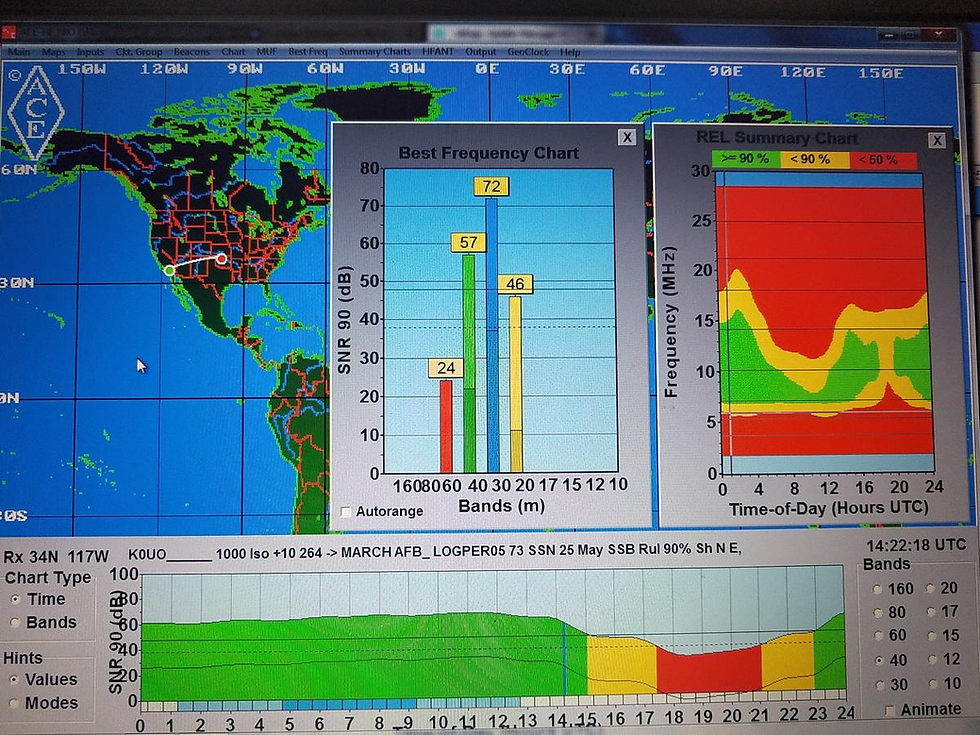
Above a path on 40 meters from March AFB to K0UO/DoD an AI & Automated Integration: Using dynamic band management and AI-assisted remote software, the station monitors band conditions in real time and automatically switches the relays in milliseconds to the best antenna for a specific target region or frequency.
By utilizing spatial separation at the HF transmitter, the system effectively mitigates the severe challenges posed by multipath fading, polarization shifts, and ionospheric scintillation that are characteristic of long-distance HF shortwave communications.
Understanding Multipath Fading Multipath fading occurs when signals travel from the transmitter to the receiver via multiple paths due to reflection, refraction, and diffraction. This phenomenon is particularly pronounced in shortwave communications, where signals can bounce off various surfaces such as buildings, mountains, and the ionosphere. The result is that the receiver may experience varying signal strengths and phases, leading to significant fluctuations in the quality of the received signal. By implementing spatial separation techniques, the system can ensure that multiple antennas are positioned in such a way that they capture the incoming signals from different angles or paths. This diversity in signal reception helps to average out the effects of fading, thereby enhancing the reliability and clarity of the communication.
Addressing Polarization Shifts Polarization shifts occur when electromagnetic wave orientations change as they travel through the atmosphere, affecting long-distance communications, especially in HF frequencies. This can cause a mismatch between transmitted and received signal polarizations, degrading performance. Using multiple antennas at the transmitter to send signals in different polarizations ensures that if one is affected by atmospheric conditions, others may remain stable, maintaining communication quality.
Counteracting Ionospheric Scintillation Ionospheric scintillation causes rapid fluctuations in signal amplitude and phase due to irregularities in the ionosphere, leading to signal fading and interruptions. Spatial separation can utilize multiple signal paths affected differently by ionospheric conditions, enhancing communication link robustness and allowing advanced signal processing to mitigate scintillation impacts.
Combating Ionospheric Scintillation:
Mechanism: Fluctuations in ionospheric electron density cause phase jitter and rapid amplitude fading, especially on trans-equatorial or polar paths.
Solution: Spatial decorrelation of transmitted wavefields reduces the likelihood of simultaneous degradation by ionospheric irregularities.

Spatial diversity in MIMO (multiple-input multiple-output) systems used in modern wireless communications can be used at K0UO. MISO/MIMO Integration: Serves as the foundation for modern HF MIMO (Multiple-Input Multiple-Output) systems, providing high-reliability data links over thousands of kilometers.
Multiplexing / Spatial Streams: Advanced software-defined radios (SDRs) process these independent propagation paths simultaneously.
Diversity Combining: Advanced algorithms (such as Maximum Ratio Combining) reconstruct the data streams at the receiver end, boosting the effective Signal-to-Noise Ratio (SNR).
In summary, the strategic use of spatial separation at the transmitter plays a pivotal role in overcoming the inherent challenges associated with long-distance HF shortwave communications. By addressing multipath fading, polarization shifts, and ionospheric scintillation through diverse antenna configurations and signal processing methods, the system significantly improves the quality and reliability of the communication. This approach ensures that users can maintain effective communication over vast distances, even in the face of adverse atmospheric conditions. Limitation in HF: Because the HF ionospheric channel changes rapidly (coherent time can be seconds or milliseconds), real-time feedback overhead can be challenging, however using AI now, this is a game changer.
This approach is similar to spatial diversity in MIMO (multiple-input multiple-output) systems used in modern wireless communications, but usually without simultaneous MIMO processing. Instead, operators rely on manual or semi-automated selection aided by real-time propagation monitoring.
The TAPR Digital Communications Conference (DCC) proceedings, especially the 2001 paper by N2MJI, provide valuable insights into early experiments with spatial diversity on HF.
Practical Examples from Contest and DX Stations
Many big contest and DX stations could use multi-antenna farms to gain diversity benefits without explicitly calling it MIMO. They would switch or phase antennas to maintain a stronger signal during contests or DXpeditions. For example:
A station may switch between two rhombic antennas pointed in slightly different directions to avoid deep fades.
Another station might phase two curtain arrays to improve signal strength on a particular band.
Operators like K0UO use software-defined radios (SDRs) like the Flex Radio or Icom IC-7610 or IC-7760, which support phase-synchronous reception, allowing better diversity combining on the receive side. https://www.k0uo.com/post/are-the-bands-open
These setups help maintain stable communications during challenging propagation conditions, especially for analog modes like SSB and digital modes such as FT8 or VARA.

Tools and Techniques for Diversity on HF
Amateur radio operators can use several tools to achieve diversity gains:
Diversity receive: Using spaced antennas and software to combine signals from multiple receivers.
Robust digital modes: Modes like Olivia, FreeDV, ARDOP, and VARA include forward error correction (FEC), interleaving, and multi-tone modulation to handle fading.
Multi-channel SDRs: Platforms such as FlexRadio, Apache Labs, and Hermes allow simultaneous processing of multiple antenna inputs.
These tools help reduce the impact of fading and improve overall communication reliability.
Challenges to Full MIMO Implementation on HF
While spatial transmit diversity is effective, implementing full MIMO on HF faces several challenges:
Antenna spacing and coupling: HF wavelengths are long, requiring large physical separation to achieve independent channels. Mutual coupling between antennas can degrade performance.
Channel estimation and synchronization: The ionosphere introduces long and variable delays, making it difficult to estimate and synchronize multiple channels accurately.
Regulatory constraints: Using multiple transmitters or antennas must comply with emission regulations to avoid interference.
Hardware requirements: Full MIMO requires multiple coherent transceivers or advanced SDRs capable of simultaneous multi-channel transmission and reception.
Because of these challenges, most HF operators use simpler diversity techniques rather than full MIMO.

The diagram is split into two comparison scenarios, illustrating both the physical setup and the signal performance metrics that a competitor would see.
Panel 1 (Left/Top): The Problem — A Conventional Single-Transmitter Station
This is how most stations operate: one radio, one antenna choice at a time. The problem in an HF contest is Fading (QSB) and Spatial Nulls.
The Physical View: The station utilizes a single large, high-gain Yagi array (Antenna A) on a 15-meter tower. A single transmit path is active.
The Performance View:
Receiver 1 (in Europe, for example): The single path from Antenna A encounters a specific ionospheric null (a destructive interference zone). The receiving station's signal meter drops, and the contact is lost (indicated by the red QSB lines and fading waveform). In a contest, this means a missed multiplier.
Receiver 2 (in South America): This path avoids the null, resulting in a strong, workable signal.
The Math: The signal strength graph shows deep, rapid spikes below the Copyable Threshold, demonstrating severe QSB.
Panel 2 (Right/Bottom): The Solution — A Station with Spatial Transmit Diversity
This station uses the principles from the previous analysis. They leverage two simultaneous, uncorrelated paths on the same band to fill in the gaps.
The Physical View ('Contest Station Map'):
The station now utilizes two different antenna systems separated significantly: Antenna A (DX High, say 15m) and Antenna B (DX Low/Broad, say 10m or a vertical loop).
They are spaced at 60 Meters apart (which, at 7 MHz, provides good separation, achieving true spatial decorrelation).
The System Diagram ('Transceiver Connection'):
A modern dual-TX transceiver (like many FlexRadio or Icom SDRs) feeds both Antenna A and Antenna B simultaneously. An 'Antenna Matrix Switch' handles the power dividing and phasing.
The Performance View:
We now have two different propagation paths. The green waveforms show how Antenna B fills in the gaps left by Antenna A.
Receiver 1: While the path from Antenna A might be in a deep fade (as seen in Panel 1), the path from Antenna B is strong. The combined effect is a constantly readable signal at Receiver 1. The multiplier is logged.
The Math: The graphs now show Consistent Strength above the Copyable Threshold because the paths are uncorrelated. If one path fails, the other holds the link.
Summary: Key DX Contest Benefits Demonstrated
Deep QSB Mitigation: Maintain a continuous, strong presence, ensuring weak stations can copy your CQ.
Eliminate Blind Spots: Reach geographically distinct multipliers simultaneously by illuminating different elevation and azimuthal angles.
Combined Coverage: Effectively utilize high-angle and low-angle paths at once, maximizing potential contacts across different distances.

Emerging Research and Experimental Efforts
Steven Walz K0UO, and a DoD/Government contractor, is conducting experiments and research on the application of AI in MIMO-OFDM (orthogonal frequency-division multiplexing) for HF data and voice communications. Users of GNU Radio and academic papers are exploring space-frequency and space-time-frequency coding schemes tailored for HF channels. However, on-air amateur results are largely anecdotal, and practical implementations are still limited.
Summary and Next Steps for HF Operators
Spatial transmit diversity using large antenna farms offers a practical way to reduce fading and improve HF communication reliability. By transmitting the same signal through multiple antennas with different propagation paths, operators can mitigate deep fades and maintain stronger signals.
1. Practical Contest Applications & Operating Benefits using AI and Diversity TX & RX
A. "Pumping Up" Low-Angle vs. High-Angle Coverage Simultaneously
Instead of switching between a high stack (for DX) and a low antenna (for close-in domestic multipliers), transmitting on two spatially separated antennas simultaneously allows a station to illuminate multiple elevation angles.
Contest Impact: You don’t miss weak domestic multipliers while calling or running European/Asian DX stations on high bands (20m−10m).
B. Mitigating Selective Fading (QSB) During "Run" Operations
When operating as a "Run" station (calling CQ and holding a frequency):
If a single transmit antenna enters an ionospheric null toward a specific geographic region (e.g., Central Europe), stations in that area will perceive your signal as fading out completely and stop trying to work you.
With spatial transmit diversity, the secondary spatially separated antenna maintains signal strength during deep localized fades, ensuring a continuous, strong CQ presence on the band.
C. Overcoming Horizontal/Vertical Polarization Shifts
Ionospheric reflection alters wave polarization continuously (Faraday rotation).
Combining physical horizontal separation with vertical separation (or mixed polarization, like a vertical array paired with a spatial dipole/yagi array) ensures that if the receiving station's antenna is orthogonal to wave vector A, wave vector B still couples efficiently into their antenna.
2. Technical Implementations for a Ham Contest Station
Depending on contest category rules (e.g., CQ WW, ARRL DX) and hardware, hams use a few specific methods to achieve spatial diversity on transmit:
Strategy 1: Active Phase Steering / Broadside Array (Coherent Phase)
Setup: Two identical antennas (e.g., two vertical arrays or two Yagis spaced horizontally at ≥1λ) fed from a single transmitter via a power splitter and an adjustable delay line / phaser (like a stacked Yagi phaser or hybrid coupler). K0UO is using Rhombics, V Beams Curtain Arrays, 4 squares, and LPDAs.
How it helps in a contest: Allows the operator to dynamically shift the main radiation lobe broadside or end-fire, "filling in" geographic nulls across populated contest zones without turning physical rotators.
Strategy 2: Multi-Transmitting / Incoherent Dual-Source (STBC or Offset)
Setup: Utilizing modern SDR transceivers with dual independent TX channels or combining two synchronized transmitters driving two separated antennas on the same band.
Digital Modes (FT8 / FT4 / RTTY Contesting): Space-Time Block Coding (STBC) techniques can be implemented directly in software/SDR modems, sending orthogonal data streams across two antennas to double link reliability for weak contest signals.
CW/SSB: Sending slightly delayed or phase-shifted RF components (Cyclic Delay Diversity) eliminates the destructive interference point in the far field, broadening the effective spatial footprint of the signal.
Strategy 3: Multi-Band/Multi-Directional Combined CQing
In Multi-Op categories, stations often use automated antenna matrix switches (e.g., StackMatch or custom PIN-diode switches) to bridge spatially separated arrays across the antenna farm, combining signals into a single unified RF burst.
3. Contest Rule Considerations & Constraints
Before implementing spatial transmit diversity in a sanctioned contest, pay attention to these rule parameters:
The 500-Meter (or 1-Kilometer) Rule: Most major contest rules (ARRL, CQ WW) stipulate that all transmitters, receivers, and antennas must be located within a continuous physical circle (typically a 500-meter diameter or about 50 arces). Your spatially separated transmit antennas must remain within this boundary. The K0UO site has many arrays setup to meet this rule.
Single-Signal Rule: Most Single-Operator categories restrict you to emitting one single signal on the air at any given moment. If using two transmitters for transmit diversity, both RF signals must carry the exact same frequency, modulation, and content simultaneously (acting effectively as one compound signal) to comply with single-signal rules.

These units have multi-canceller technology can cancel over multi-octave bandwidths, mitigating RF interference from large signals and the accompanying transmitter broadband noise and spurious signals.
Operators interested in exploring this technique should consider:
Building or using multiple directional antennas spaced apart.
Using SDRs that support phase-synchronous reception and multi-channel processing.
Experimenting with antenna phasing and switching based on real-time signal monitoring.
Trying robust digital modes that complement diversity techniques.
Using AI and real time propagation data, to automate the station for selection of the antenna with the appropriate take-off angle for the current conditions. https://www.k0uo.com/post/are-the-bands-open
While full MIMO on HF remains challenging, spatial transmit diversity provides a valuable tool for serious contesters, DXers, and experimenters seeking more stable HF links.
"Over the years, my primary passion in amateur radio has been the design, modeling, and empirical testing of large-scale, high-gain HF wire arrays—particularly rhombics, V-beams, and multi-element configurations. Because of the physical space required for these traveling-wave systems, the station has evolved into a comprehensive outdoor test range. For those interested in the technical side, I’ve published the complete far-field test data, antenna models, and construction logs openly on my Blog and QRZ.com. I always welcome connecting with fellow builders and engineers who share a fascination with classical HF propagation." 73 Steve Walz, K0UO
Now K0UO has set up a second antenna site, (which is much larger than the original site 1), re-engineering nine X-Rombic arrays with a modern design, and positioning them on a hilltop where K0UO once had a 300-foot tower. The tower's top at this location is 500 feet AGL above the surrounding ranch land, allowing for an extremely low take-off angle. These nine X Rhombic arrays have 1200 feet on each leg, equating to 18 wavelengths on each of the four legs for the 20-meter ham band, with nearly a mile of wire for each array. Offering one array for every 20 degrees of direction for worldwide coverage. This new site absolutely Dwarfs the main "K0UO Rhombic Farm".
This site is intended for Commercial, DoD, along with remote DX and Contest ham radio applications, positioned hundreds of feet above the surrounding ranch land, ensuring an environment free of RFI noise.
K0UO aims for both sites is for exceptional signal strength, low noise, wide-angle coverage without constant rotation, and adaptive optimization for fast-changing conditions. It is well-suited for DXing, experimentation, remote operation potential, and long-path or difficult conditions where high gain +SMART control helps. It is less oriented toward pure high-rate multi-operator contesting.
The two sites now can work together for diversity and remote access.
In short, the 2026 antena site number 2 represents K0UO’s push toward even higher performance through extreme height, larger fixed high-gain wire arrays, and advanced real-time smart control—positioned as a next-level experimental and operational facility beyond the already substantial main station.
K0UO antenna site number 2 is the 2026 “next level” expansion—higher elevation, bigger individual arrays, denser directional coverage, and more advanced automated/smart control. The two sites are geographically separate and can complement each other for diversity and remote operation.
The station leverages, the Land area using large arrays with SMART technology controls systems.
Diversity Receive and Transmit used 100% of the time at K0UO
See the blog below. Tip: just skip the Blogs header and go down to the blog.
Physics of QSB fading

ACE program by Long Wave Inc. (Steve Walz and his RSI Team was worked with Long Wave on a few projects and training) as a defense contractor, consider the following points:
Based in Oklahoma City, Long Wave Inc. specializes in defense technologies.
The company focuses on providing advanced solutions for military applications.
Long Wave Inc. collaborates with government agencies and military branches.
They prioritize innovation and research in defense systems.
The company is committed to meeting national security needs.
Long Wave Inc. emphasizes quality and compliance with defense regulations.

Active Facility Clearance (FCL)
RSI Corp. and Steve Walz ensures strict, continuous compliance with the National Industrial Security Program Operating Manual (NISPOM) regulations.
RSI Corp has active Classified contracts or has a documented, ongoing business need to access classified data.
RSI has a continuously employed designated Facility Security Officer (FSO) who holds a personal clearance at or above the level of the FCL
In addition to formal DCSA reviews, the company's FSO performs and documents comprehensive internal self-assessments at least annually.
The Test Range Site continuous monitoring protocols, tracking mechanisms, and security education awareness logs.
The sites objective is to always have Superior / Commendable status. Which is only Granted to pristine operations with zero critical issues, highly active security communities, and proactive vulnerability self-reporting
SEE ALL BLOGS Here, & Just Skip the first few pages, and go to the Blog List
Historic Preservation: The K0UO station diligently preserves and uses components and insulators from renowned, historic radio arrays, including those from W6AM (Don Wallace), W7YRV Roy, BBC, Voice of America (VOA), and many others.
"The K0UO station is unlike any other ham station globally," making it truly unique as a Big Gun Mega Station. It is one of the few capable of constructing and utilizing very large Rhombic and V Beams, along with a variety of other antennas and AI. K0UO features the largest operational HF wire antenna in the world.
Remote operation users
Note to contest operators, DXers, and others who have made arrangements to utilize the K0UO facility: you must first sign a non-disclosure agreement and adhere to the terms prohibiting the disclosure of the "exact location" of the K0UO site you are using. Currently, the site hosts several commercial DoD/DoW projects utilizing specific HF high-gain antennas. These projects take precedence, and you will be informed if an antenna is unavailable at certain times. There are no exceptions to this rule, as agreed upon in the original agreement, which states that certain antennas are not guaranteed and may change without notice. This is in accordance with the Department of Defense utilization clause of the site (30 days on most current agreements).
The owner of the K0UO location receives hundreds of inquiries annually regarding remote use of the station for DX, casual amateur radio use, or extensive contests, including multi-multi operations. K0UO aims to be inclusive, but due to the limited number of operators that can access the facility simultaneously, a standard protocol is necessary. If you or your group have successfully negotiated an agreement, you must comply with the non-disclosure agreement. While many contests require station location disclosure, stating that the station is in Grid Square EM07, Barber County, Kansas, does not violate the agreement; only revealing the exact location or station owner/call would constitute a breach. If approved, please enjoy the station responsibly.
The facility houses tens of thousands of dollars in new Flex 8000 transceivers, amplifiers, sophisticated control and switching equipment, some of which are AI-operated, in addition to massive HF antennas such as Rhombic, V beams, Delta Loop quad-beams, four-square verticals, stacked log periodic LPDA, wire beams dipole stacked on a 195 ft tower, and a complete array of receive antennas from Beverages to loops.
The agreement you have signed is confidential, and you are prohibited from disclosing it to others. Each agreement is tailored to meet the specific requirements of both you and the owner.


Comments