


Diversity Transmit for HF Radio at K0UO Station, Maximizing Signal Reliability

Updated: 1 day ago

Wireless HF communication often faces challenges such as signal fading, interference, and outages. For ham radio enthusiasts at the K0UO station, maintaining clear and reliable transmissions is crucial. One effective solution to these challenges is the use of Diversity Transmit HF that employs multiple transmit antennas to send the same signal through different spatial paths, significantly improving signal reliability and performance.
The KØUO Rhombic Antenna Farm in Kansas, consisting of many acres, with "Miles of Wire in the Air & On the Air". “So the RF Gotta-Go-Somewhere"! The Rhombic is truly the "PHD" of all wire antennas.

Rhombic antenna array at K0UO station enhancing transmit diversity and signal reliability
The new K0UO site as part of this project additional site number 2
THE BIG PROJECT STARTING SPRING 2026
K0UO's Major Initiative for 2026 is collaborating with a Department of Defense contractor group, utilizing the Flex ML-9600X/FPA-5K and FPA-10K (not affiliated with Flex Corp) for diversity in transmission and reception, utilizing an AI platform with real time data from many SDRs. Flex 9300/9600 radios are Mission-Ready Operations: Built for reliability and interoperability in demanding The K0UO is the most sophisticated Remote Ham site available, featuring the very user-friendly Flex systems with full AI control, and offering numerous interactive tools, such as real-time spotting and real-time band propagation conditions, through a private proprietary program similar to those used by Department of Defense and commercial groups. In fact the K0UO site is being used for a DoD and Federal Agencies project with the ML-9600X radios and the proprietary program at this time which has integration into advanced communications and ISR systems. .https://gov.flexradio.com/environments.https://edge.flexradio.com/www/offload/20250123140902/FLX_Brochure9600Series_010325.pdf
Also some antennas on site are currently assisting a group with a project using TDoA (Time Difference of Arrival) Direction Finding (DF) checking integrated statistical localization algorithm which allows the localization of HF transmitters based on AoA (Angle of Arrival). Also on RX Dynamic Active Interference Cancellation (DAIC) using AI and software is here.
Also on RX Dynamic Active Interference Cancellation (DAIC) using AI and software testing.
Also an overview of the "Amplified Re-entrant Rhombic K0UO System" as used on a DoD project, which provided reliable and efficient HF communications for a circuit to Guam from the K0UO site in Kansas. see at https://www.k0uo.com/post/understanding-re-entrant-rhombic-array-antennas-design-features-and-applications
What Is Diversity Transmit Radio?
Diversity transmit radio is a wireless communication technique using multiple antennas at the transmitter to send the same signal through different spatial paths. This method, called transmit diversity, reduces the impact of signal fading (QSB) and outages from obstacles, multipath propagation, or interference. HF multipath signals from the F layer can arrive from slightly different angles due to factors like ionospheric refraction or reflection, affecting signal quality.
Signals arriving via the ionosphere experience changes in polarization due to its dynamic and irregular nature. The ionosphere, composed of constantly moving ions, offers multiple modes and paths for signal transmission, especially at frequencies below the maximum usable frequency. Consequently, the phase and amplitude of the same signal through different paths vary constantly, causing tilting and rotation of incoming RF signals.
This HF diversity project tests true transmit diversity, a key technique to improve wireless communication reliability and performance. It involves transmitting signals from multiple antennas, enhancing signal reception and mitigating fading and interference in environments with multipath propagation. In true transmit diversity, advanced techniques like space-time coding and MIMO (Multiple Input Multiple Output) are explored. Space-time coding encodes data across time and multiple antennas, allowing simultaneous transmission of multiple data streams, increasing data rate and signal robustness. MIMO, common in commercial, DoD, and cellular systems, uses multiple antennas at both transmitter and receiver to create multiple data paths, improving bandwidth efficiency and system capacity, making it essential in modern wireless communication.
These techniques are crucial in applications from civilian telecommunications to military communications, where reliability and performance are critical. The project aims to advance wireless technologies to meet the growing demand for high-speed, reliable communication in complex environments. This research enhances academic understanding and has practical implications for developing next-generation networks supporting diverse applications, from mobile communications to defense operations.

At the K0UO station, this approach is implemented using antenna arrays such as rhombic or log-periodic dipole arrays (LPDA), for both transmit and receive. These antennas send delayed or processed versions of the same signal, ensuring that at least one signal path reaches the receiver with minimal degradation. Overall, utilizing two distinct transmission systems increases the likelihood of experiencing deep fades compared to using a single system. This is because multiple paths are more extensively excited, leading to increased multipath propagation.
The best strategy is to employ two separate antennas, selecting the most appropriate one at any given time for the path. This is effective for both receiving and transmitting. Commercial sites accomplish this by utilizing a voting system, based on either the signal-to-noise ratio or the absolute signal level.
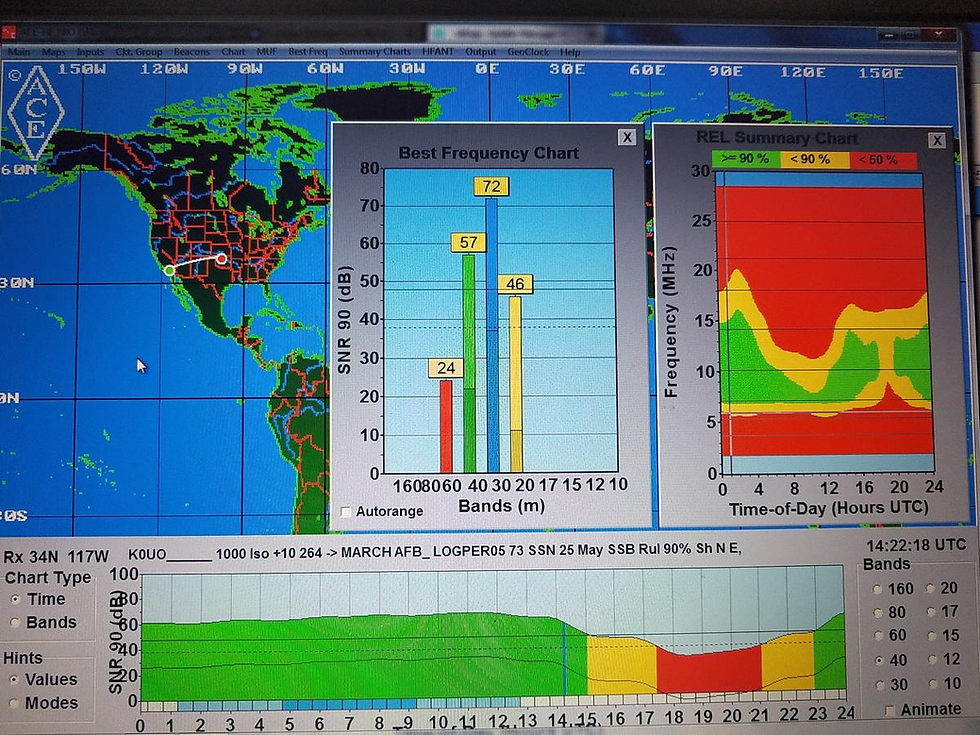
The Diversity transmit system is using AI‑assisted real time propagation and antenna optimization tools from a private ionosonde, or chirpsounder radar system for a DoD project, which refers to an ionospheric sounder operated by commercial companies, private research institutions, or private defense contractors rather than traditional public government agencies (like NOAA in the US or the Bureau of Meteorology in Australia).
AI-controlled antenna switching and along with the lightning protection matrix:
With real-time MUF, F layer, D layer absorption, and information on Sporadic E and other Solar & Aurora conditions, the AI-controlled antenna switching matrix confidently selects the best available antenna. This selection is based on conditions, direction, and the necessary takeoff angle of attack for optimal signal strength to specific DX stations, and it can be automatically chosen.
The private ionosonde, or chirpsounder radar systems used for a DoD network system project, confidently predicts HF conditions over intervals from 1 minutes to 24 hours. Along with the live DX spots, it grants the operator complete control over the extensive arrays at their disposal, enabling them to make decisions with ease. Managing the vast arrays is straightforward and effortless
Utilizing a DPS like unit (Digisonde-Portable-Sounder), a commercial high-frequency ionospheric radar, it captures electron density profiles, virtual height, Doppler spread, and wave polarization in real time with AI assistance. It assesses all parameters of HF radio signals reflected by the ionosphere and automatically computes the local ionospheric electron density profile in real time.
.K0UO (summer of 2026) now also features a Chirp Sounder which is a software-defined radio-based receiver for observing ionospheric sounders (ionosondes) and over-the-horizon radars. Now working with the AI-assisted propagation optimization control system, this is a major advancement for the station.
MIL-STD-188-141 compliant framework, both 3G ALE (STANAG 4538 / Appendix C) and 4G ALE (Wideband HF / Appendix G)
While public ionosondes belong to global open-access networks, private systems are typically deployed to provide proprietary, hyper-local, or high-resolution data for specific defense, aerospace, or commercial communications needs.
How Diversity Transmit Radio Works
The core idea behind diversity transmit radio is to exploit the differences in signal paths created by multiple antennas. Here’s how it works in practice:
Multiple antennas transmit the same signal: Each antenna sends a version of the signal, sometimes with slight delays or processing to improve performance.
To achieve optimal performance, it is recommended that diversity antennas be spaced at a distance exceeding two wavelengths. Both antennas should exhibit similar directive patterns and maintain comparable signal-to-noise ratios. It is important to note that polarization diversity is typically effective only at higher frequency bands.
Signals experience different QSB fading: Due to obstacles, reflections, and interference, each signal path undergoes unique fading characteristics.
Reduced probability of deep QSB fade: Because all paths are unlikely to fade simultaneously, the system maintains a stronger and more reliable connection.
Integration into advanced communications and ISR systems.
Polarization Diversity: Using both a vertical and horizontal antenna due to ionospheric interaction wave mixing incoming skywave signal become elliptically or circularly polarized. However a linear polarization mismatch can cause up to 20 dB loss in the near field, this is less critical on long distance DX paths.
Polarization refers to the orientation of the hypothetical flux lines within the electric field. In the context of the far-field phenomenon known as electromagnetic (EM) radiation, the imaginary electric and magnetic flux lines are oriented perpendicularly to each other. Although either field could serve as the reference standard for polarization, the electric field has been established as the polarization reference.
Imaginary flux lines illustrate the force of electric fields, existing only at specific angles in limited space. We cannot generate two polarizations simultaneously at any point in space when broadcasting signals, regardless of the antenna. The idea of dual-polarization transmissions likely arises from misunderstandings of antenna modeling programs or incorrect perceptions of antenna function.
Modeling programs show two filtered views of the electric field, as a complete depiction of its tilt or angle is too complex for a flat screen. While it's possible to view a slice of the field showing true polarization at any angle and distance, these programs often omit the phase relationship between intensities, obscuring actual polarization understanding. Due to the random and continuously changing nature of phase delay, so just employing circular or dual polarization can significantly amplify fading when multiple paths converge at the receiver.

K0UO HF Log LPDA beams on tower towers, designed for long-range signal transmission, the array can be phased.
At K0UO, the use of HF rhombic arrays and LPDA antennas takes advantage of spatial diversity, which is especially useful in environments with complex terrain or urban obstacles. K0UO is using just his one site (site number 2 is coming online), but is utilizing multiple antennas spread out over many acres. All system now using AI self-healing for automatically changing from malfunctioning radios, bad rotor boxes and the arrays and station controls as needed.
So get up some very good antennas. Many people believe that you need a vertical or horizontal antenna for diversity, however that is not needed. The RF signals are coming in at different angles from the F layer at different times, and distances. You want to capture all those signals, so the more distance between your antennas and capture area will have a big effect. The station always uses one or more of the Rhombic antennas, and either uses a dipole, 4 Square verticals, a delta loop beam, HRS Curtain array, or one of more of the LPDA logs beams.
You could even to start, just combine your existing antenna with a loop, dipole, end feed, or vertical antenna, and you will see big differences, at different times of the day on different frequencies.
The most effective transmission strategy involves maintaining a variety of antennas and selecting the one best suited for the specific band, distance, direction, and time of day. Without feedback from the receiver, this process can be speculative. However, by applying real-time band propagation data, with AI which will significantly enhance this process.
Benefits of Using Diversity Transmit Radio at K0UO Station

Implementing diversity transmit radio offers several advantages for ham radio operators:
Improved reliability in fading environments: Multiple transmit paths reduce the chance of signal loss due to fading.
Better performance in interference-limited scenarios: Transmit diversity helps maintain signal clarity even when interference is present.
Compatibility with limited receiver antennas: The system works effectively even if the receiver has only one or a few antennas, which is common in mobile or portable devices.
Enhanced communication range: By reducing outages, the effective communication distance can increase.
Resilience to circuit failures: If one antenna or path fails, others continue to transmit, maintaining the connection.
These benefits make diversity transmit radio a practical choice for DX and Contester, along with other ham radio enthusiasts who want to maximize their station’s performance.

Practical Implementation at K0UO Station
At K0UO, the diversity transmit system is carefully designed to optimize signal paths:
Rhombic antenna arrays: These antennas provide directional gain and multiple spatial paths, ideal for long-distance DX, The rhombic arrays use no rotor, the switches and relays do the work 14 directions, every 25 degrees, so every direction every time https://www.k0uo.com/post/the-king-of-wire-antennas-is-a-rhombic
Log-periodic dipole arrays (LPDA): Used for their wide bandwidth and directional properties, which can be phase at different heights for changing transmitter take off angle LPDAs complement rhombic arrays by covering different frequency ranges or directions. https://www.k0uo.com/post/log-periodic-dipole-array-or-lpda
HRS Curtain: Also used for bandwidth and directional properties, it can be phase at different heights for changing transmitter take off angles, and is steerable, it covers Europe and the Mediterranean areas. This antenna is fixed at 30 degrees. but steerable, plus or minus 30° using electronic phasing (90 degrees total). The upper Array is at about 190 feet, the lower Array is at 100 feet. This antenna is designed with steerable directivity and wave angle phasing. https://www.k0uo.com/post/current-distributed-feed-system-as-used-on-sterba-curtains-will-be-utilized-on-the-new-antenna
Signal processing: The transmitted signals may be delayed or phase-shifted to maximize diversity gain.
Receiver setup: Although the receiver may have limited antennas, it uses combining techniques to extract the best possible signal from the multiple paths. Read the link at the end of this Blog for receiver diversity, which is used 100% of the time at the K0UO station.

K0UO Diversity Overview

Why Does K0UO Utilize Rhombic Arrays? This configuration ensures that K0UO’s transmissions remain robust and clear, even under challenging QSB conditions.
A rhombic traveling wave antenna is so large, that the fading QSB patterns do not align uniformly across its structure. As a result, destructive interference at one location is counterbalanced by constructive interference at another, leading to a more stable, fade-resistant signal. This stability is crucial for effective communication in amateur radio operations and applies to both transmission and reception.
Do not underestimate the performance of the Rhombic or V Beam array unless you have personally constructed and used one. Due to their substantial size, often spanning several acres, these antennas offer a significant advantage by utilizing thousands of feet of wire elevated in the air. This design enhances transmit and receive signal diversity, by launching and capturing signals at various times and angles, effectively minimizing fading (QSB), and transmitting RF in a similar manner.
Traveling wave antennas are unique and differ greatly from many widely used antennas. This significant advantage cannot be demonstrated by antenna modeling programs

Real-World Example: Overcoming Urban Interference
Imagine a station operating in an area with many buildings and reflective surfaces. A single antenna transmission might suffer from deep fades caused by multipath interference. By using diversity transmit radio with verticals and LPDA beams antennas, the station sends multiple versions of the signal through different paths. Some signals may reflect off buildings, while others travel directly. The receiver combines these signals, reducing the chance that all paths are blocked or faded at once. This results in a more stable and reliable communication link.

Tips for Ham Radio Operators Interested in Diversity Transmit
If you want to implement diversity transmit radio at your station, consider these practical tips:
Choose antennas with complementary patterns: Combining directional antennas like rhombic arrays with broadband antennas such as LPDAs can cover more spatial paths.
Use signal processing wisely: Introducing delays or phase shifts can enhance diversity gain.
Test different antenna placements: Spatial separation between antennas improves the effectiveness of diversity.
Monitor signal quality: Use tools to measure QSB fading and interference to optimize your setup. Use remote SDRs, real time data, along with the help from AI.
Start simple: Even two antennas can provide noticeable improvements before expanding to more complex arrays.
Complexity: Implementing advanced communication systems with large antennas and AI requires a high level of coordination among multiple antennas and sophisticated signal processing techniques at the transmitter. This coordination encompasses not only the physical arrangement of the antennas, but also the algorithms that govern signal transmission and reception. The complexity stems from the necessity to synchronize signal transmission from different antennas, to ensure effective combination at the receiver, thereby minimizing interference and maximizing signal quality. Furthermore, signal processing must consider various environmental factors, such as multipath propagation and fading, which can significantly impact the performance of the communication system. Consequently, engineers must design robust systems capable of adapting to changing conditions while maintaining optimal performance, where AI has proven to be an invaluable tool for K0UO.
Throughput vs. reliability: In the realm of HF communication, a critical trade-off exists between throughput and reliability. Transmit diversity is a technique that is primarily focused on enhancing the reliability of data transmission by utilizing multiple antennas to send the same signal over different paths. This approach significantly reduces the likelihood of data loss, especially in challenging environments where signal degradation is common. However, this focus on reliability often comes at the expense of raw data rates, as the available bandwidth may be shared among multiple signals. To address this issue, engineers have developed methods to combine transmit diversity with multiplexing techniques, which allow for the simultaneous transmission of multiple data streams. This combination can effectively balance the need for high reliability with the demand for increased throughput, thereby optimizing overall system performance. By carefully managing the interplay between these two factors, communication systems can achieve a level of efficiency that meets the needs of modern applications, where both speed and dependability are paramount.
Interference Cancellation Technology (ICT) or DACI samples the interfering system's transmission to create an opposite interference signal. This anti-interference signal is added to the protected radio's receiving path, canceling out interference and ensuring clear reception. ICT/DACI can reduce unwanted signals by over 90 dB, restoring effective communication.
Eliminating RF interference under real-world conditions
ICT/DACI is designed for Department of Defense tactical operations in combat situations.
AIMS is scalable to provide electromagnetic interference protection for one to many victim receivers from one to many interference sources. AIMS can be applied to protect a wide range of spectrum, from HF to above X Band, for either narrowband or broadband signals. AIMS can remove up to 100 dB or more of interference before the signal reaches the victim receiver.
Summary
Diversity transmit radio at K0UO station demonstrates how multiple HF transmit antennas can significantly improve signal reliability and performance. By sending the same signal through different spatial paths and combining them at the receiver, this system reduces QSB fading, interference, and outages. The use of rhombic arrays and LPDA antennas at K0UO provides a practical example of how transmit diversity can enhance ham radio communications.
The new larger K0UO site as part of this project additional site number 2
Diversity Receive
Diversity receive is used 100% of the time, at K0UO also.
See the blog below. Tip: just skip the Blogs header and go down to the blog.
Physics of QSB fading
Scientific Research Projects
K0UO's RF-quiet environment enables the collection of raw data on Sun-ionosphere interactions and other geophysical phenomena. This data, including noise and signal measurements, forms a substantial dataset crucial for understanding the Sun's effects on Earth, now and in the future.

SEE ALL BLOGS Here, & Just Skip the first few pages, and go to the Blog List
Remote operation users
Note to contest operators, DXers, and remote users of the K0UO facility: You must sign a non-disclosure agreement and keep the "exact location" of the K0UO site confidential. The site hosts priority DOD/DOW projects using specific HF high-gain antennas. You will be notified if an antenna is unavailable, as per the original agreement, which states certain antennas are not guaranteed and may change without notice, following the Department of Defense utilization clause (30 days on most agreements).
The K0UO location owner receives many inquiries annually for remote station use for DX, casual amateur radio, or contests. Due to limited access, a protocol is required. If you have an agreement, you must comply with the non-disclosure terms. While contest location disclosure is often required, stating the station is in Grid Square EM07, Barber County, Kansas, is allowed; revealing the exact location or owner/call breaches the agreement. If approved, enjoy the station responsibly.
The facility includes valuable equipment like Flex 8000 transceivers, amplifiers, advanced control systems, and massive HF antennas, including Rhombic, V beams, Delta Loop quad-beams, and more.
The agreement is confidential, prohibiting disclosure to others. This ensures sensitive information remains protected. Each agreement is customized to meet specific needs, fostering trust and communication while safeguarding interests. Breaching confidentiality can result in legal consequences and loss of trust. Respect the agreement terms and maintain confidentiality at all times.


Comments