


Outdoor Test Range Site, RSI Corp

Updated: 27 minutes ago

The RSI Corp antenna test range (also known as the K0UO Antenna Test Facility, "Antenna University," or K0UO Rhombic Farm/ATF), is a large-scale outdoor far-field antenna testing and development site integrated with 4KS Walz Airport in Kiowa, Kansas.
Despite the use of high-precision electromagnetic modeling software, such as NEC-2, NEC-4, HFSS, AN-SOF and Scilab model computer simulations depend on idealized mathematical conditions. Real-world far-field testing continues to be the gold standard for antenna validation, as it considers environmental variables and physical interactions that software cannot fully predict.
It is operated by Steven E. "Steve" Walz (radio callsign K0UO), who founded and directs RSI Corporation (full name: Radiofrequency Safety International), an Environmental Health & Safety (EH&S) firm specializing in onsite RF/electromagnetic energy (EME), EMF along with all general safety compliance at telecommunication, power utilities. broadcasting, AI data, government, network operation centers (NOC), and most work sites, by conducting safety surveys, EHS reviews, and training.
For equipment testing, The outdoor range leverages the airport's long open spaces and the surrounding rural, electromagnetically quiet 1,200+ acres of prairie/farmland on owned or nearby oil field roads right-a-ways in the Gypsum Hills area for real-world, anechoic-chamber-free testing.
We are actively collaborating with several groups on various designs in the areas mentioned below and welcome additional partnerships.

Location and Airport Integration
4KS Walz Airport is a public-use, privately owned turf-strip airport about 4 miles northwest of Kiowa, KS (FAA identifier 4KS; coordinates approx. 37°02'43"N 098°34'13"W; elevation 1,387 ft). Steve Walz is the owner/operator.
Test range: For ISR equipment testing is expanding a number of miles to the west and north of 4KS Walz Airport, for ISR, EME, RFI and RF test site number 2, by RSI Corp. Used as part of Vance AFB 1D MOA DAF Proposed Action which has been approved is to obtain new airspace that affords the 71 FTW and other groups autonomous scheduling and ensures nearby access to airspace necessary to perform low-altitude non-hazardous flight training and equipment testing.

Runway 3/21 is 2,525 ft × 50 ft (usable ~2,900–3,000 ft with displaced thresholds marked by cones). It has low-intensity edge lights, wind socks, and typical rural obstructions (trees, fences, oil wells/pumps, silos, and a prominent 195-ft tower—FCC ASR #1216715—near midfield ~375 ft east of centerline).
The antenna test range runs parallel to the runway, providing over 2,500 ft of clear far-field distance (Fraunhofer zone) plus access to 1,000+ acres for extended measurements. Portable towers, drones, and tie-down pads on concrete north of the hangar support setup. The airport sees general aviation (Cessna, etc.), short-field training, and beginning mid-2025: DoD/ISR contractor use, including test aircraft with electro-optical/infrared sensors, tactical radios, and data links.
Allsopp Helikites are in use at the site when needed.
Note, this K0UO blog uses dB gain, not dBi when providing antenna gain data.
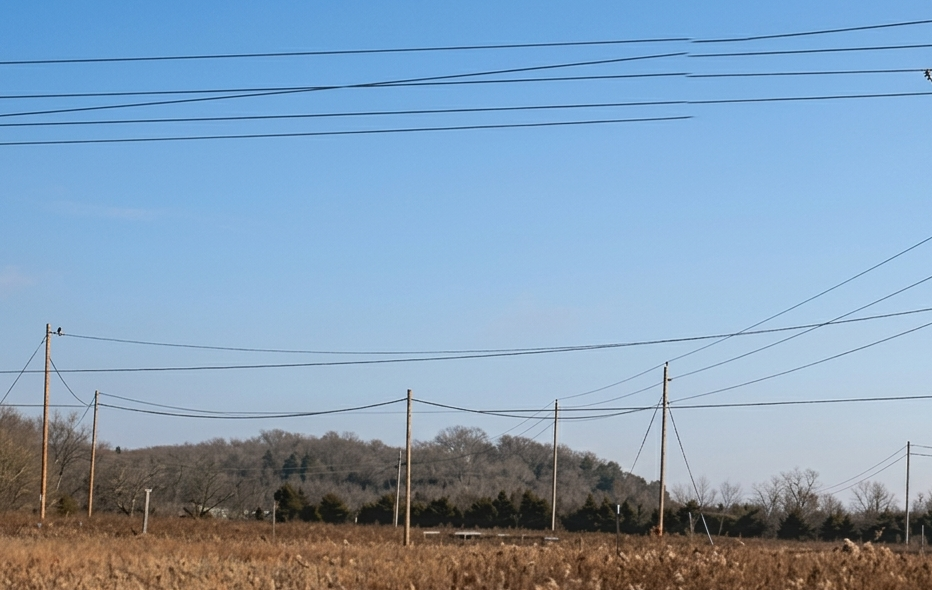
Facilities and Capabilities
The site features the world's largest amateur (ham) high-frequency (HF) wire antenna installations by land area, tower count/height, and antenna quantity/gain, still being used today.
Rhombic arrays (re-entrant designs for ~90%+ efficiency and high forward gain, no terminating-resistor power loss), V-beams, curtain arrays, stacked LPDA-Yagis, four-square phased verticals, Beverages (receive), and more—covering 160 m to 2 m bands with optimized takeoff angles.
Support structures: Towers/poles 50–195+ ft (wood, Rohn, etc.), concrete silos, oil-well infrastructure repurposed.

Stand-alone towers: RSI Corp and K0UO/R has access to a series of dedicated stand-alone towers up to 500 feet tall (and no other users on these towers) specifically designed for HF to MW operations as well as for far-field testing of antennas. These towers are uniquely positioned, standing tall and isolated in a very rural ranching setting, ensuring that no other antennas are mounted on them or interference . This strategic setup allows for optimal performance and minimal interference, making them ideal for serious professional projrcts. Think about how these towers could be uses by your group and project no of test rang site has this enique opportunity with unlimited possibilities. Located at a distance of up to 20 miles from the main 4KS airport RSI Corp site on the east side of the Kansas Red Gyp Hill ranching area, these towers are part of an extensive test range that facilitates a variety of radio frequency experiments and competitions. All can be connected with a private microwave internet point-to-point backbone network.
The towers are registered with the FCC Antenna Structure Registration (ASR) system. Several notable structures are listed, including the following:
#1,216,715 at a height of 59.5 meters on site,
#1,252,737 reaching 70.2 meters,
#1,252,738 towering at 89.6 meters,
#1,260,299 standing at 42.6 meters,
#1,314,639 at 88.4 meters,
#1,216,786 reaching a height of 97.5 meters,
#1,252,503 at 77.7 meters,
#1,235,485 at an impressive height of 149.4 meters dedicated to FM broadcasting,
and finally, ASR# 1,252,009 standing at 85.30 meters.

Testing setup: NEC5/HFTA modeling first, followed by real far-field measurements (IEEE/MIL-STD protocols). Equipment includes calibrated Wandel & Goltermann EMR meters (E/H fields), spectrum analyzers, vector network analyzers, drones for 3D heat-map/pattern flights, portable crank-up towers, GPS/laser surveying, soil resistivity (Wenner 4-point method), and real-time data systems.
Measurements cover: Gain, radiation patterns (azimuth/elevation), beamwidth, front-to-back ratio, side lobes, impedance, ground loss/reflections, and regulatory compliance. Repeatability checks (5+ runs, RMS uncertainty) ensure precision for DOD, ham contesting/DX, commercial wireless, broadcast, and hyperscale AI data-center/MOC applications.
Key Reasons Far-Field Testing Is Necessary Beyond Modeling
1. Inhomogeneous Ground & Real-World Soil Effects
Modeling Limits: Antenna modeling software typically assumes a uniform, flat ground plane with fixed values for conductivity ($\sigma$) and permittivity ($\epsilon$).
Real-World Reality: Real ground composition varies across acres, changes dynamically with moisture/weather, and contains underground mineral deposits or water tables. Because wire arrays rely heavily on ground reflections (or ground-return paths for vertical polarization), far-field measurements reveal how actual local ground characteristics distort the elevation pattern and gain.
2. Physical & Mechanical Tolerances
Modeling Limits: Models assume perfectly straight wires, exact element angles, uniform wire tension, and precise spacing.
Real-World Reality: Real wire antennas experience sag, temperature expansion, mechanical stress, surrounding vegetation interference, and slight structural deviations on support masts or towers. Far-field measurements capture the true combined radiation pattern resulting from these unavoidable physical imperfections.
3. Near-Field Environmental Coupling
Modeling Limits: Modeling every adjacent object—such as neighboring towers, guy wires, power lines, fences, surrounding buildings, or nearby trees—requires immense computing power and precise 3D modeling of every structure's material properties.
Real-World Reality: Unintended reradiation or inductive coupling from nearby metallic structures can significantly alter far-field main lobes, fill in expected nulls, or distort side lobes. Far-field testing directly measures the cumulative impact of the entire operational environment.
4. Feed System & Component Losses
Modeling Limits: Software calculates theoretical feed impedances and ideal currents, but it often simplifies component losses in transformers, baluns, common-mode choke currents, and coax/ladder-line feed systems.
Real-World Reality: Far-field testing verifies actual radiated power efficiency and confirms whether feed-line radiation or phase mismatches are skewing directivity.
Ground: Soil loss
5. True Far-Field Distance Validation
Wavefront Planarity: An antenna's radiation pattern changes as energy transitions from the reactive near-field ($R < \frac{2D^2}{\lambda}$) to the radiating far-field. Far-field testing ensures that measurements are taken at a distance where the incoming or outgoing wavefront is essentially planar, accurately reflecting how the antenna will launch long-distance (DX) signals.

It is electromagnetically quiet with excellent soil for grounding, making it ideal for precise, repeatable results without indoor chamber limitations. Most HF antennas made for ham radio and used by DXers & Contesters have not even been tested in the far field on a outdoor antenna test range
Connection to RSI Corp and Broader Use

RSI Corp (headquartered at 543 Main St., Kiowa, KS; est. 1997 post-Telecom Act of 1996) focuses on RF safety: MPE assessments, hazard reports, OSHA/FCC/EPA/FAA compliance for (Verizon, AT&T, T-Mobile), DoD, Google, UPS, NOC and AI data centers. The K0UO range doubles as RSI's controlled antenna and RF/EMP/EMI safety test range for hands-on training. Test range location https://maps.app.goo.gl/cEKCoMn5f5YHsCDy5
Superior Survey Techniques™ (SST) course: A 2-day professional certification with classroom + practical surveys on Day 2 using site equipment/instruments. Targets RF safety pros; annual renewal required.
STEM/"Antenna University" role: Outdoor real-world lab for university aerospace/antenna research, high-school aviation (via KDOT), and ARDC programs. Invites groups for projects; AI tools aid analysis.

The test range is strategically located in a quiet RF environment, allowing for the collection of raw data on ionosphere, EMI interactions and the sun, and other geophysical aspects. This data, including noise and signal level measurements, enhances our understanding of the Sun's effects on our space environment and planet. These interactions impact our natural environment, power grid, telecommunications, and satellite navigation systems.
Current and future contributions are expanding a growing repository of raw data, potentially offering new insights into these effects and interactions.
K0UO's Major Initiative at this time is collaborating with a Department of Defense group, utilizing the Flex ML-9600X/FPA-5K and FPA-10K (not affiliated with Flex Corp) for diversity in transmission and reception, utilizing an AI platform.
A current project at the Range, is testing an AI‑assisted real time propagation and antenna optimization tools from a private ionosonde radar system for the DoD.
Also some antennas on site are currently assisting a group with a project using TDoA (Time Difference of Arrival) Direction Finding (DF) checking integrated statistical localization algorithm which allows the localization of HF transmitters based on AoA (Angle of Arrival).
Military/DoD tie-ins: Supports ISR testing, special training ops at 4KS (e.g., SkyRaider II OA-1K, T-6/T-7A training under nearby MOAs), and EH&S for defense sites.

AI for Drone‑Based RF Pattern Measurement
The RSI/K0UO antenna test range uses drones to map far‑field patterns.
AI is used for:
Noise filtering
Pattern reconstruction
Data smoothing
Comparing measured vs. modeled patterns
Tools in this category include:
Computer‑vision ML models
RF‑pattern regression models
AI‑based anomaly detection
This is standard in modern RF test ranges.
We once relied on calculators, and some of us even remember using slide rules and pencils before transitioning to computer modeling. It's remarkable how far we've advanced, and in just a few years, AI will undoubtedly further revolutionize antenna design.
Artificial Intelligence (AI) and Machine Learning (M/L) are transforming how engineers analyze, design, and troubleshoot complex antenna radiation patterns. In traditional RF (Radio Frequency) engineering, evaluating massive setups—like multi-element wire arrays or phased arrays—demands immense mathematical computation or weeks of field testing
AI overcomes these challenges by automating pattern recognition and predicting electromagnetic behavior in real time. We are already utilizing it on the test range.
The facility is at the forefront of the AI movement, conducting tests on antennas, and smart antenna control systems that incorporate AI for both amateur, and commercial applications. These antennas are engineered to manage complex propagation conditions and interference, making them ideal for the Department of Defense, High-Frequency stock trading groups, and broadcasters who require the utmost reliability.

Gold Standard RF Safety Surveyor Certification Class
The RSI Superior Survey Techniques™ training course is a university based program, developed over a quarter of a century ago by RSI. RSI is the original RF safety expert and literally wrote the book on RF survey ("Superior Survey Techniques", SST (RF), which is now an industry standard and best practice. This course is the advanced application of scientific sampling techniques necessary for professional health and safety hygiene reports. Participants must be highly qualified and it is strongly recommended attendees have ongoing compliance programs and hold certification such as RSI’s Train the Trainer or Advanced Train the Trainer or an equivalent.

This tried and true scientifically based offering consists of two days of intensive training focused on industry standards for safe and technically sound RF survey data collection.
The first day is comprised of comprehensive classroom instruction taught by qualified RSI RF safety Instructors.

The second day involves practical hands-on experience, using established methods for RF survey data collection. Participants will perform surveys at RSI’s Controlled Antenna RF Safety test range. Attendees are encouraged to bring their test equipment and a variety of equipment will be onsite for participant usage.
RSI’s original proven training is the only hands on course available, and is designed to build a solid foundation for RF data survey collection. Upon completion of this course, participants will be trained in procedures that are uniform throughout the industry, used nationally, and have withstood scrutiny from a variety of governmental entities including the FCC. They will be certified RF safety surveyors.

The team at RSI Corp. - Radiofrequency Safety International has a proven history of successfully providing certified EH&S EME/RFR compliant surveys, safety training, and solutions to thousands of industry and RF Telecom professionals. RSI courses fulfill the certification requirements for AT&T, Verizon, Rockwell, Collins Aerospace, AIRINC, Bechtel, DoD, Motorola, Black & Veatch, various utility companies, government entities, broadcasters, and most major cell carriers and their contracting organizations. Our authorized OSHA outreach trainers have decades of practical experience, allowing them to deliver safety solutions that ensure compliance with OSHA, FCC, EPA, and FAA regulations while prioritizing employee safety.
Additional Context
The site emphasizes the scientific method: model → build → far-field test → refine. It is FAA-registered and supports day-to-dark ops (non-standard lighting). For visits, STEM inquiries, or testing: see k0uo.com (detailed blog posts on rhombics, ground, testing) or rsicorp.com; contact via k0uo@arrl.net or RSI at (620) 825-4600 / (888) 830-5648.
NOW 2026
100% remote workers and online training and safety programs 24 hours a day 30 years of serving the world, from Kiowa KS in Barber County
The RSI Corp outdoor testing range site at the 4KS Walz Airport
In short, it's a unique, practical blend of advanced engineering, professional safety infrastructure, educational outreach, and aviation support—all centered around the 4KS runway in rural Kansas. If you're local or planning a visit (or if this is for a specific project), more details are readily available on the linked sites.

Active Facility Clearance (FCL)
RSI Corp. and Steve Walz ensures strict, continuous compliance with the National Industrial Security Program Operating Manual (NISPOM) regulations.
RSI Corp has active Classified contracts or has a documented, ongoing business need to access classified data.
RSI has a continuously employed designated Facility Security Officer (FSO) who holds a personal clearance at or above the level of the FCL
In addition to formal DCSA reviews, the company's FSO performs and documents comprehensive internal self-assessments at least annually.
The Test Range Site continuous monitoring protocols, tracking mechanisms, and security education awareness logs.
The sites objective is to always have Superior / Commendable status. Which is only Granted to pristine operations with zero critical issues, highly active security communities, and proactive vulnerability self-reporting
Scientific Research Projects
K0UO's RF-quiet environment is an exceptional setting that significantly enhances the ability to conduct scientific research focused on various interactions, particularly those between the Sun and the ionosphere, as well as other geophysical phenomena. This unique environment minimizes radio frequency interference, allowing researchers to collect high-quality raw data that is essential for a range of scientific investigations. The data collected encompasses a variety of measurements, including both noise and signal levels, which are critical for analyzing the complex interactions that occur between solar activity and the Earth's atmosphere.
The dataset obtained from these measurements is not merely a collection of numbers; it represents a comprehensive resource that is pivotal for advancing our understanding of the Sun's influence on Earth. By studying this data, scientists can gain insights into how solar flares, coronal mass ejections, and other solar phenomena impact the ionosphere, which in turn affects communication systems, navigation, and even power grids on the planet. Furthermore, understanding these interactions is crucial for predicting space weather events that can have significant implications for technology and human activities.
Moreover, this research is not limited to immediate applications; it also plays a vital role in long-term studies aimed at understanding the evolving relationship between solar activity and Earth's climate systems. As we continue to grapple with the effects of climate change, the data gathered in K0UO's RF-quiet environment will be invaluable in modeling and predicting future scenarios based on solar influences. This ongoing research will contribute to a broader understanding of the Earth's atmosphere and its responses to both natural and anthropogenic changes, ultimately helping to inform policy decisions and preparedness strategies for dealing with the impacts of solar activity on our planet.
.
T: 888-830-5648
F: 620-825-4324

The test range site makes use of the 4KS Walz Public airport, known as "Antenna University", and its surrounding area as a practical learning environment for STEM (Scientific, Technical, Engineering, & Mathematics) projects in a real-world outdoor setting. The site has a large outdoor area with a variety of terrain types for conducting user defined experiments. If your group has a University aerospace. safety or antenna research STEM program, please let me know.
We support the Amateur Radio Digital Communications and their STEM programs.
K0UO is part of HamSCI, the Ham Radio Science Citizen Investigation, which serves as a platform to promote projects aligned with these goals:
Enhance scientific research and understanding through amateur radio activities.
Encourage the creation of new technologies to support this research.
Offer educational opportunities for both the amateur community and the general public.
HamSCI facilitates collaboration between professional researchers and amateur radio operators. It helps establish and maintain standards and agreements among all participants.
What is HamSCI's scientific focus?
HamSCI was initiated by ham-scientists who explore upper atmospheric and space physics. They realized that projects like the Reverse Beacon Network, WSPRNet, PSKReporter, DX Cluster, ClubLog, and others are producing extensive data sets that could offer valuable insights into the Earth's ionosphere and related systems. Consequently, HamSCI initially concentrates on these research areas. In the future, additional researchers may join and expand its scope. For scientists, collaborating with the amateur radio community provides access to individually managed stations, available in the hundreds across numerous countries, with receive and transmit capabilities across the electromagnetic spectrum, easily identifiable in areas of interest and deployable to remote locations.
Science Questions
How does the ionosphere react to inputs from space and the neutral atmosphere?
How does the ionosphere interact with the neutral atmosphere and space?
What causes medium and large scale traveling ionospheric disturbances?
What are the origins of Sporadic E?
Amateur Radio Questions
How do phenomena like solar flares, geomagnetic storms, and traveling ionospheric disturbances impact radio wave propagation?
How does ionospheric science assist amateur radio operators in enhancing communications?
How can I leverage my existing radio equipment for scientific initiatives?
SEE ALL BLOGS Here, & Just Skip the first few pages, and go to the Blog List


Comments