


Steven Walz K0UO Innovating Amateur Radio with AI Smart Antenna Control and STEM Collaboration

Updated: 1 day ago
Large amateur radio stations can do more than work rare DX and win contests. When an HF site is built with research-grade antennas, software control, repeatable testing, and open peer review, it becomes a practical radio science lab.

That is the role Steven Walz, K0UO, is building around. The work described around K0UO, RSI Corp’s outdoor test range, the research lab, training programs, and the large HF antenna sites known as Site 1 and Site 2 points to a station model that sits somewhere between serious amateur radio, commercial telecommunications, government-style field testing, and STEM education.
The reason it matters is simple: HF radio still has unanswered practical questions. Propagation changes by season, solar cycle, time of day, terrain, noise level, antenna pattern, hardware tolerances, and operating mode. A station that can collect data, compare antenna systems, train operators, test station automation, and invite peer review can add value far beyond one operator’s logbook.


K0UO is treating amateur radio as an applied research platform
Amateur radio has always had a research purpose. In the United States, FCC Part 97.1 lists several bases for the amateur service, including advancing the radio art, improving technical and communication skills, and expanding the pool of trained radio operators. That legal purpose is often quoted, but only a small number of stations are built at a scale where it can be tested across many systems at once.
K0UO’s approach is different because the station is not being treated only as a personal operating position. It is being used as a practical test bed. That means antennas, receivers, controls, operating procedures, training, and data systems all matter.
A contest station may focus on rate, signal strength, and reliability during a weekend. A DX station may focus on hearing weak signals and turning contacts into confirmed results. A research-oriented HF station adds another layer. It asks questions such as:
Which antenna performs better under the same propagation conditions?
Can automated control reduce operator error without reducing operator judgment?
Can received-signal data help predict which path is about to open?
Can students learn RF engineering faster when they can compare real antenna behavior with theory?
Can test results help both ham radio and commercial wireless work?
Those questions fit the kind of station K0UO is building. The station becomes a place where operating, measurement, engineering, and education meet.
AI smart antenna control changes what a station can measure
A large HF site has many moving parts. Antennas may cover different bands, directions, elevation angles, polarizations, and path types. Switching them manually is possible, but it does not scale well when the goal is repeatable testing.
This is where AI and smart station control become useful. The value is not a vague claim that software can “run everything.” The value comes from connecting sensors, radios, antenna switches, rotators, receivers, logging tools, and propagation data in a way that supports better decisions.
A SMART station can use data such as:
Signal-to-noise ratio from multiple receivers
Band opening reports from networks such as the Reverse Beacon Network, WSPR, and PSK Reporter
Real-time contest and DX cluster spots
Solar and geomagnetic indices from public space weather sources
Antenna selection, heading, and timing data
Historical station performance by band, path, and time

K0UO/R equipment with AI assist
AI can then assist with pattern recognition. For example, it can flag when a band is opening earlier than expected, compare antenna A and antenna B under similar conditions, or suggest a likely best antenna for a target region. The operator still makes the final call, but the software gives the operator better data.
That is the practical meaning behind AI ham radio SMART antennas largest HF stations contest DX RemoteHamRadio data building blocks. The phrase sounds broad, but the core idea is specific: collect station data, connect control systems, compare real results, and turn those results into better operating and engineering choices.
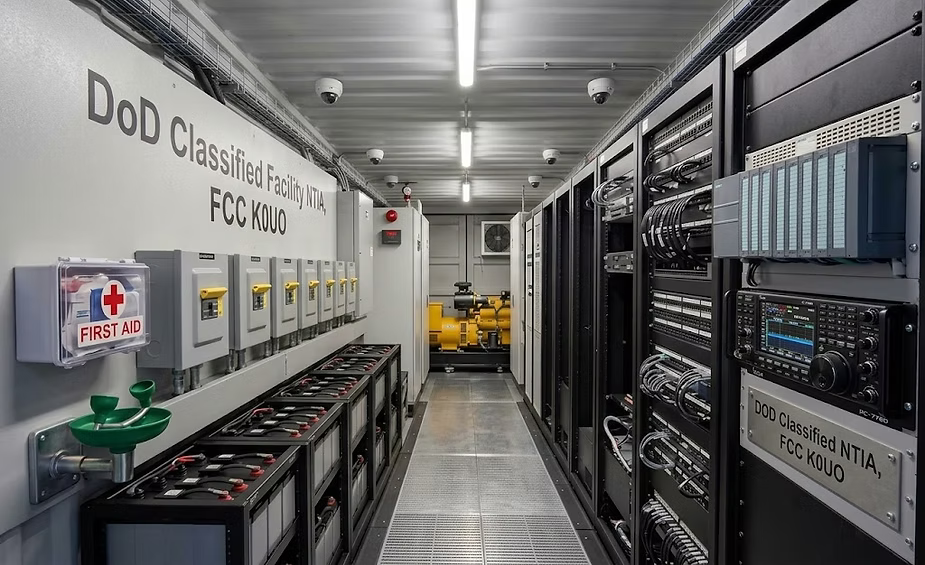
For commercial and DoD telecommunications and research groups, this matters because HF remains useful where infrastructure is limited, damaged, overloaded, or intentionally avoided. Government and emergency communications work also keeps interest in HF alive because ionospheric paths can support long-distance links without satellites or towers between the endpoints.
The antenna field is the instrument
In radio, the antenna is often the largest and most expensive part of the system, and it is usually the part that determines whether a station hears well. Receivers, amplifiers, and software matter, but an antenna field with space, height, and directional options creates possibilities that a smaller station cannot match.
The K0UO work described around the RSI Corp outdoor test range and the large HF ham radio antenna Site 1 and Site 2 appears to treat the antenna farm as the main research instrument. That is the right way to think about it.
A well-built HF test site can compare systems under real skywave conditions. Lab equipment can measure impedance, loss, and pattern estimates. Modeling software, such as NEC-based tools, can predict behavior. But real HF operation adds the ionosphere, ground conductivity, local noise, weather effects, maintenance realities, and human procedures.
That is why large physical sites remain valuable. They let a team test questions that cannot be answered fully from a bench.
Research need | Why a large HF site helps |
Antenna comparison | Multiple antennas can be tested on the same band and path under similar time conditions. |
Directional performance | Large wire arrays and towers can support patterns that small lots cannot. |
Noise studies | Separating receive antennas and test points helps identify local and environmental noise. |
Training | Students and operators can see theory, construction, measurement, and operation in one place. |
Peer review | Other operators and engineers can repeat checks, review methods, and challenge results. |
For a station using Rhombic arrays, towers, voice skimmer, station AI SMART antenna control technology STEM, peer review, the scale of the physical plant matters as much as the code. Voice and CW skimmer-style systems can watch signal activity. Towers and wire arrays provide physical choices. Smart control helps compare those choices. Peer review helps keep the conclusions honest.
Commercial and government projects bring discipline to amateur experimentation
Amateur radio culture values experimentation, but serious R&D work adds a different kind of discipline. Commercial and government projects require clearer documentation, repeatable methods, controlled tests, safety planning, construction standards, and results that other people can inspect.

The K0UO model, as described, builds on that kind of project history. Completed R&D, engineering, and construction work matters because large HF systems are not simple installations. They involve land use, grounding, feed-line planning, tower safety, switching systems, lightning protection, equipment shelters, RF exposure awareness, and long-term maintenance.
Those concerns are familiar in commercial telecommunications. They also show up in government-style field work, where systems must be tested under real operating conditions rather than ideal ones.
That background can raise the quality of ham radio experimentation. A station designed with project controls can document:
What was built
Why a design was chosen
How it was measured
What failed during testing
What changed after review
Which results repeated and which did not
That last point is critical. A single impressive contact does not prove an antenna design. A weekend of good reports does not prove a control system. Repeatable evidence, shared methods, and outside review make the results more useful.
RSI Corp’s outdoor test range gives the work a field environment
A lab can isolate variables. An outdoor test range exposes them.
The work described at RSI Corp’s outdoor test range, research lab, training facilities, and HF antenna sites creates a rare mix. It allows teams to move between design, construction, operation, and measurement without treating those steps as separate worlds.
That matters because radio systems fail in practical ways. Connectors corrode. Relays age. Feed lines absorb water. Ground systems behave differently after weather changes. Noise sources appear and disappear. Software automation must handle hardware that does not always respond perfectly.
A field range can reveal those problems faster than a paper design. It also gives STEM groups and university partners a better learning environment.
Students can model an antenna in software, help build or inspect part of the system, compare modeled results with on-air data, and then discuss why the results differ. That is a stronger educational loop than a classroom-only exercise.

STEM and university collaboration turn station data into shared knowledge
The strongest part of this model is the commitment to sharing findings and data. Amateur radio improves fastest when operators publish what worked, what did not work, and how others can check the result.
STEM and university collaboration can push that further. Radio is an unusually good teaching platform because it combines many subjects in one system:
Physics through wave propagation and the ionosphere
Electrical engineering through antennas, matching networks, filters, and receivers
Computer science through logging, control systems, AI models, and data pipelines
Mechanical design through towers, supports, weatherproofing, and field construction
Statistics through measurement uncertainty, repeatability, and signal analysis
A station such as K0UO can give students and researchers real data sets. That data may include received signal strength, time, frequency, antenna selection, bearing, mode, station location, and propagation context. With privacy and licensing handled properly, those records can support useful projects.
For example, a student team might compare skimmer reports across antennas during a contest. Another group might study how geomagnetic disturbances affected high-latitude paths. A university lab could test whether a model can predict the best antenna choice based on recent band behavior.
None of this requires hype. It requires clean records, careful metadata, and a willingness to let other people challenge the method.
Peer review keeps large claims grounded
Large stations can attract large claims. That is why peer review matters.
Peer review in amateur radio does not always look like academic journal review. It can include independent operators checking results, engineers reviewing station diagrams, contest data being compared against logs and public spotting networks, or university partners testing whether a conclusion survives a different method.
Good peer review asks plain questions:
Was the comparison fair?
Were the antennas tested at the same time or under changing propagation?
Was received signal strength measured the same way?
Were local noise and directionality considered?
Can another station reproduce the finding?
Is the data available in a form that others can inspect?
K0UO’s stated practice of inviting peer review is important because it separates serious work from station mythology. Every large station has stories. Research needs records.
This attitude also helps commercial and government collaborators. They need confidence that a field result is not just a one-time event. Documentation and review make the work easier to trust and easier to improve.
Why this model matters for the future of HF radio
HF radio has gone through cycles of being dismissed and rediscovered. Satellites, fiber, cellular systems, and internet networks handle huge amounts of global communication. Yet HF continues to serve roles that are hard to replace.
It can cross oceans without intermediate infrastructure. It can operate from remote areas. It can support backup communication. It can be built, repaired, and understood by trained operators. It also gives researchers a real-world channel for studying the ionosphere and spectrum use.
What Steven Walz, K0UO, is doing fits that future because it combines the best parts of several worlds:
The curiosity and independence of amateur radio
The documentation habits of engineering projects
The field discipline of commercial and government testing
The teaching value of STEM work
The scale of a serious HF antenna site
The data methods of AI-assisted station control
That mix is rare. It also gives ham radio a stronger case for relevance. The station is not only making contacts. It is building methods, training people, testing systems, and sharing results that others can review.
The takeaway is clear: the next major advances in amateur radio will not come only from better radios or bigger antennas. They will come from stations that connect hardware, software, data, education, and peer review in one working system. K0UO is showing what that can look like at full scale.
Also See RSI Corp @ https://en.wikipedia.org/wiki/RSI_Corporation


Comments