


DELTA LOOP HF BEAM Muli-Element

Updated: Sep 23

Antennas.....before Amplification
This Blog is writen by Steve Walz K0UO
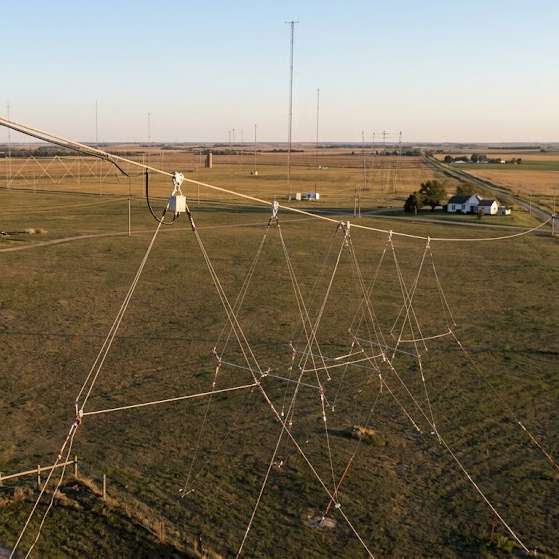
The K0UO station possess a 40-meter wire Delta-loop multi element beam that originally started as a 6-element setup. This design is notable for its wide spacing, an important feature that enhances the antenna's performance. However, following thorough testing and analysis, I opted to simplify the design by decreasing the number of elements from six to four. This change not only made the antenna's structure more streamlined but also improved its overall efficiency. The new configuration closely resembles a quad beam antenna, recognized for its excellent directional properties and gain.
The antenna is fixed in one direction, which is a strategic choice that allows for focused signal transmission and reception. This fixed orientation is achieved by hinging the antenna from a catenary line that runs between two tall towers. The use of a catenary line is particularly beneficial as it helps to maintain the tension of the wire, ensuring that the antenna remains in optimal shape and alignment, which is essential for effective performance.
The HF Delta loop beam will beat a yagi every time, K0UO with the RSI Corp antenna Far Field Test Range uses advanced RF measurement to confirm all the antennas preformance.

During my experimentation with the original 5-element setup, I conducted both practical tests and theoretical modeling, with assistance from WA7ARK, an expert in antenna design and modeling. Far field survey testing was performed on site, as this array is installed at the K0UO & RSI Corp far field antenna test range. The results from both the empirical testing and the simulations indicated that the sixth and fifth elements, despite being widely spaced, exhibited minimal current flow. This lack of current in the fifth element suggested that it was not contributing effectively to the antenna's overall performance. As a result, I realized that taking out this element would not only streamline the design but would also lower the wind load.
Overview
Delta Loop beam antenna is essentially a type of quad (loop) antenna, specifically a triangular variant of a full-wave loop element.
Polarization & Feed: Feeding point affects polarization (horizontal or vertical) and takeoff angle in both.
Both are full-wave loop antennas (perimeter ≈ 1 wavelength) and belong to the broader family of parasitic loop arrays.
Testing of both antennas in the air, shows the Delta with .2 dB to .4dB more gain. However modeling gives the Quad +.3 to .5 dB more, our tests in the far field show that this is do to the Deltas over all higher height above ground, the Quad has the lower part of its wire closer to the ground, so it has ground loss and a higher take of angle.
The Real-World Difference: The difference is only about 0.3 dB. In the real world, human ears cannot detect a difference
Both antennas excel here compared to standard dipoles or verticals because they are closed loops, making them less susceptible to local man-made electrical noise (QRM).
Polarization: On both antennas, your feed point determines your polarization.
Feeding a Delta Loop at the center of the bottom wire yields horizontal polarization; feeding it one-quarter wavelength down from the apex on the side yields vertical polarization.
Feeding a Quad at the bottom corner yields horizontal polarization; feeding it at a side corner yields vertical polarization.
I feed mine at the top, using the top support line to hold the coax. Symmetrical Radiation Pattern
Feeding at the top apex creates a highly symmetrical current distribution down the two sloping legs of the triangle. This results in a clean, broadside radiation pattern perpendicular to the plane of the wire loop, with excellent front-to-back or front-to-side rejection if configured as a beam.
Slight Loss in Low-Angle DX Gain
Compared to feeding a point-down Delta Loop at the bottom, top-feeding can cause a slight reduction roughly 0.3 dB in ultra-low-angle radiation. Because the maximum current concentration is at the top feed point rather than closer to the earth, the ground interaction changes slightly, occasionally yielding a marginally higher takeoff angle in the model. For most operators, this minor theoretical difference is completely unnoticeable in daily operation. But the slight loss in the model, really shows up as gain, on the real world test on the antenna range of +.2dB.
So I choose a top-feed configuration which has nothing to do with physics and everything to do with structural engineering:
Easy Coax Routing: If your Delta Loop is suspended from one high catenary line, tower, or tree limb, the feed point is already at the highest, most secure structural support anchor.
No Hanging Cable Strain: You can bond your coaxial cable directly to the main support rope or messenger cable. This removes the physical weight and wind-yank of a heavy coax drop dangling from the center of a floating bottom wire, preventing wire stretching or connection failures over time.
Reduced ground loss through top feeding, not initially indicated in modeling, but discovered and confirmed during extensive field testing and optimization.
Top feeding is a win win for my setup.
K0UO emphasizes the scientific method: model → build → far-field test → refine

Yagi or Delta Loop Beam
At present, most HF amateur radio Yagi and Hex beam antennas, along with a large number of commercial HF beams, have not been subjected to rigorous testing on antenna test ranges. This lack of formal testing raises important questions about the performance and reliability of these antennas in real-world conditions. Many amateur radio enthusiasts rely on specifications and marketing claims made by manufacturers, but without empirical data from controlled tests, these claims can often be misleading or overly optimistic.
Informal testing has been conducted on many VHF and higher frequency band antennas, thanks to organizations like The Central States VHF Society and Microwave Update. These dedicated groups have established amateur test ranges at their annual conferences, providing a platform for hobbyists and professionals alike to evaluate antenna performance. These events are invaluable as they not only foster community engagement but also uncover shortcomings in some manufacturers' models and their associated claims. Participants can share insights, compare results, and collectively improve their understanding of antenna design and performance.
However, despite the advancements in testing practices for VHF and UHF antennas, there remains a glaring gap in the realm of HF antennas. The absence of comprehensive real-world far-field testing for HF Yagi antennas, including wire-based Hex-Beams and high-performance Yagi beams, is a significant oversight in the amateur radio community. This lack of testing means that many users may purchase antennas based on incomplete or exaggerated performance data, which can lead to frustration and disappointment when the antennas do not perform as expected in actual operating conditions. As a result, much of the manufacturers' documentation might mislead consumers, creating a cycle of misinformation that affects both new and experienced operators alike.
FACT: The Delta Loop Beam provides better performance than a Yagi with the same boom length. The HF Delta loop beam will beat a yagi every time
This assertion about the Delta Loop Beam versus the Yagi is not merely anecdotal; it is supported by various studies and user experiences within the amateur radio community. The Delta Loop configuration, known for its unique geometry, often exhibits superior gain and radiation characteristics compared to traditional Yagi designs when both antennas are compared with equivalent boom lengths. The Delta Loop's ability to radiate energy more efficiently can lead to clearer signals and improved communication over long distances, which is a critical factor for amateur radio operators looking to make contacts across the globe.
Furthermore, the Delta Loop's design allows for a more compact setup, which can be advantageous in limited space situations, such as urban environments or small backyards. This makes the Delta Loop an attractive option for many operators who may not have the luxury of installing large Yagi antennas. Additionally, the omnidirectional properties of some Delta Loop configurations can provide flexibility in signal directionality, allowing operators to adapt to changing conditions without the need for extensive reconfiguration.
In conclusion, while both Yagi and Delta Loop antennas have their place in the amateur radio toolbox, the current lack of standardized testing for HF antennas underscores the importance of seeking out reliable data and user experiences. As the community continues to advocate for better testing practices, operators are encouraged to share their findings and consider alternative designs that may offer enhanced performance, such as the Delta Loop Beam, particularly in applications where space and efficiency are paramount.
K0UO with the RSI Corp antenna Far Field Test Range uses advanced RF measurement to confirm all the antennas preformance.
The decision to move to a 4-element configuration has proven to be beneficial, as it maximizes the performance of the antenna while minimizing unnecessary complexity. The remaining elements are now better utilized, and the overall gain and directivity of the antenna have improved as a result of this thoughtful redesign. This experience underscores the importance of careful testing and modeling in antenna design, as it can lead to significant improvements in performance and functionality.
So a wide spaced design, using 4 elements is the way to go, with a tested 13.65 dBi of gain on the 100 foot height.
The Delta Loop design was selected due to its higher gain, improved front-to-back ratio, and because it didn't necessitate a different setup than hanging an inverted V wire Yagi-type beam.

The K0UO's system is fed from the top, and modeling indicates a minor reduction in low-angle gain (0.5). This was not a significant issue, as the main priority was the ease of feeding. The coaxial cable was bonded to the support line to facilitate this process. During extensive field testing and optimization, it was discovered and confirmed that the system exhibited reduced ground loss and an increased gain of +.3 dB.
Unlike a Quad beam, the Delta Beam the loop only needs 2 ground guys per element instead of 3 or 4 for a Quad.
WA7ARK Model below


Front-to-Rear (F/R) Ratio: The ratio of the maximum power density radiated in the forward direction (0∘) to the peak power density found anywhere within the entire rear hemisphere (typically 90∘ to 270∘). This serves as a “worst-case” performance metric, indicating how effectively the antenna suppresses unwanted radiation or interference across the entire back half of its pattern.
Front-to-Back (F/B) Ratio: The ratio of the maximum power density in the forward direction (0∘) to the power density radiated precisely in the opposite direction (180∘). This is a point-specific measurement that characterizes the antenna’s isolation from signals coming directly from behind it. Unlike the F/R ratio, it does not account for secondary lobes or “hot spots” elsewhere in the rear hemisphere.


So what happens if you add more elements?
It is a waste, on this beam using wire elements, see the data below.
WA7ARK Model, This array is fed at the apex of the Driven Element. Optimized for forward gain (weight=3 most important), then f/b and f/r (weight=2), and finally for Swr(50) (weight=1, least important).
All dimensions are in feet, except wire diameter.


Exactly like a wire inverted V except you're using Delta Loop elements. As building a quad except the elements are three sided.
The K0UO slopes down down like wire V yagi, and the third forms the complete wire on the bottom. Quad spacing is a good, start but optimized designs like WA5ARK did, will gives you additional gain.
Use isosceles triangle geometry for better gain.
Add reflector and directors for beam functionality and increased gain.
Use a loop length calculator to determine wire length: a full-wave loop is approximately (1005 / f) feet, where (f) is frequency in MHz

Delta loops are sometimes preferred over quad loops, particularly for beams, due to their simpler construction and comparable performance. The design of delta loops is inherently more straightforward, allowing for easier assembly and installation. This simplicity is particularly beneficial for amateur radio operators or hobbyists who may not have extensive experience with complex antenna systems. Additionally, delta loops can be constructed with readily available materials, making them a cost-effective option for many users. When it comes to performance, delta loops can match the efficiency and gain of quad loops, especially in certain frequency bands, making them an attractive alternative for those looking to optimize their signal transmission and reception.
One of the notable advantages of delta loops is their versatility in polarization. They can be fed for either horizontal or vertical polarization, which provides operators with flexibility depending on the specific requirements of their communication needs. This adaptability is particularly useful in varying propagation conditions and can help to ensure better signal quality and strength.
Furthermore, delta loops can perform remarkably well even when installed close to the ground, which is a significant advantage in situations where space is limited or when operating from locations with restrictions on antenna height. Their low-angle radiation characteristics make them suitable for working with stations at varying distances, enhancing their effectiveness in both local and long-range communications. Overall, the combination of ease of construction, performance reliability, polarization versatility, and effective operation at lower heights makes delta loops a favored choice for many radio enthusiasts.

HOW TO BUILD one for yourself
Simulate your design using NEC2 or others before building.
Terminate legs properly to maintain traveling wave behavior, and to avoid reflections.
Select Loop Configuration
Point-up triangle: Better for vertical polarization.
Point-down triangle: Easier to feed from the bottom.
Use isosceles triangle geometry for better gain and dual polarization.
Gather Materials
Insulated wire (e.g., 14 AWG or stronger)
Balun ( 2:1 depending on impedance)
Coaxial feedline with CMC choke
Support structures (trees, masts, poles)
Rope or cord for tensioning and support
Construct the Loop
Form the triangle using wire and supports.
Feed at a corner or midpoint of the base for desired polarization.
Use a balun or coax stub at the feed point to match impedance.
Tune and Test
Use an antenna analyzer to check SWR.
Adjust wire lengths or feed point position for optimal performance.
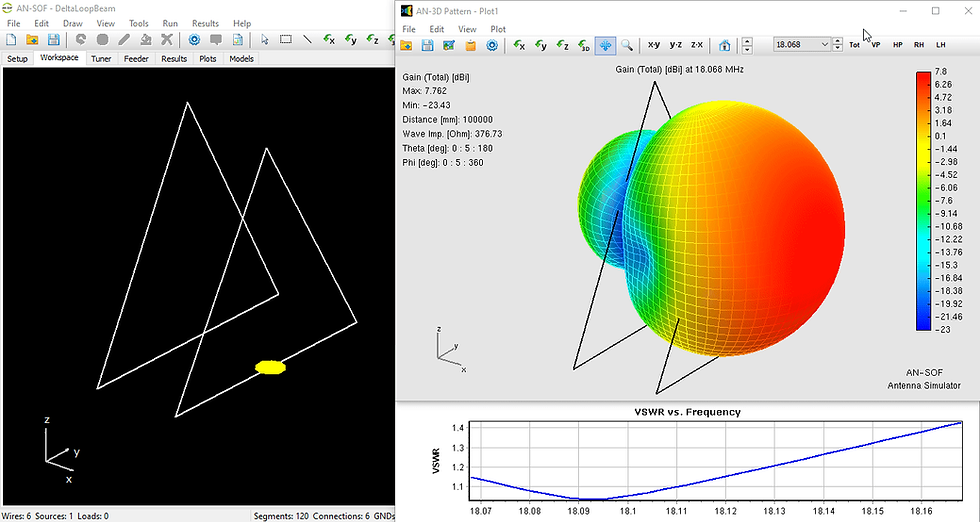
Check this out, a Delta Loop Simulator, AN-SOF model
SEE for dimensions WB3AYW Delta Loop Beam Using an isosceles triangle
The Best Antenna is one that is "In the Air and On the Air"! As any good antenna experimenter knows, the more antennas the better, that way you can test and see how they are really working. You won't know you have a good antenna if you can't compare it with others!
The K0UO antenna test range utilizes the 4KS Walz airport and its vicinity as a hands-on learning environment for STEM (Science, Technology, Engineering, & Mathematics) antenna projects in a real-world outdoor context. If your group is involved in a university aerospace or antenna research STEM program, please inform me.
Also RSI Corp in Barber Country KS works with Hyperscale AI Data and Network operation Centers for years.
K0UO near Kiowa, KS hasBoasts High-Performance Antennas: Featuring large High Frequency (HF) stacked LPDA-Yagi beams, Rhombics, V Beams, Curtain arrays, and Four-square phased verticals on specific bands, these antennas are optimized for low noise and offer very efficient high gain.
The KØUO Rhombic Antenna Farm and Antenna Test Range: Home to the World's Largest amateur radio (ham), High Frequency (HF) Wire Arrays, with miles of wire both in the air and on the air daily.


SEE ALL BLOGS Here, & Just Skip the first few pages, and go to the Blog List


I just built a 4 el for 20 meters, I really works much better than the wire yagi beam.😄
Thank You
A High gain easy to build antenna