חוות אנטנות מעוינות K0UO


The Mighty Rhombic is the "KING of Wire Antennas".
This is Scientific Technical Engineering, & Mathematics (STEM), Blog Site for the K0UO Antenna University, The Lost Art of the Nostalgic Classic Rhombics Arrays
The blog site has design, modeling, and construction information for building large HF Rhombic arrays, V-Beams wire arrays, HRS Curtain arrays, Long wire, baluns, LPDA Log yagi, Feed-lines, Beverage receive antennas, BOG, Traveling Wave antennas, Delta loop multi element beams, Diversity transmit HF radio, lightning protection, & antenna vibration dampening. Info on Icom Diversity receive for the IC7610, IC7760, & FlexRadio along with overviews on previous other large Rhombic sites, VOA, W6AM, and W7YRV which are no longer in use. Blog topics about the K0UO Rhombic farm and antenna test range, 4KS Walz Airport near Kiowa, KS.
Steven Walz, known as K0UO which is his amateur ham radio station call, has an antenna testing range site known as "Antenna University". The Primary Rhombic Antenna Farm site 1, Site # 2, & RSI Test Range, which has the use the 4KS airport, for far field measurements, using portable towers and large drones, loaded with calibrated RF survey instruments for Commercial, Amateur Radio, STEM, DOD, school or University Research. Decades of building huge arrays, teaching, and performing RF surveys.
This site can be viewed in numerous languages check your browser and language flag
Just skip the header pages and go down to the blog now
See the Blog list check @
Then click on each blogs Header that you want to read.
Also just see each CATEGORY LIST and click on the blog you want to read
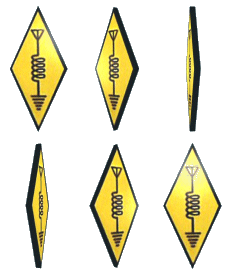
The ARRL, RSGB, Switzerland, and so many other amateur radio organizations use the Diamond Logo, which looks like a Rhombic antenna. "K0UO has, Miles of WIRE, in the AIR, and ON the AIR daily"
Steve Walz known as K0UO (his FCC Amateur radio call), is working on the "Lost Art of Rhombics" with four of these large wire antennas, at 100 to 160 foot high, X-Rhombic, and three 1200 foot V-Beams (VEE) antennas at the Kiowa, Kansas QTH. Which are beaming to fourteen DX areas, with phasing for more steering. There is also information on large distributed fed curtains arrays, LPDA, and beverage receive antennas. K0UO is home of the Re-entrant Rhombic, which is 90% efficient by re-phasing the power instead of heating up termination resistors. The Rohn R20, 25, 35, 45, 55, 65G, Rigid Tube Tower Series 26KD Tower, the J Tower, and the C Tower are reviewed.
"I have contacted 200 countries on 160 meters, and it wouldn't have been possible without the beverage antennas.
The K0UO antenna farm is proudly using parts from many previous world class legendary stations, to continues the tradition they started with the big arrays, like the VOR (Voice of America), Armed Forces Radio, DoD, W6AM Don Wallace, BBC, Art Bell W6OBB Big Loop, W7YRV Roy Callison, and others. So symbolically those large Nostalgic historic stations are still, "On the Air Daily" by K0UO using an extensive array of towers and antennas, the largest HF ham arrays still in use today. Also read about the K0UO Remote ham station. K0UO/R @ https://www.qrz.com/db/K0UO/R
See my call on QRZ, https://www.qrz.com/db/K0UO, or type in my call K0UO for more information and photos. Each Rhombic antenna uses 1000s of feet of 3/8" cable for the array wire, covering many acres each. They are erected on numerous towers and 100 foot wooden utility poles, also the site has three large V-Beam antennas which are over 1200 foot long each. Miles of wire in the air and on the air, spread out over many acres. "Build Them and the DX will Come"!
The K0UO Rhombic Farm is the now the largest & highest gain HF ham wire antennas array farm, currently still in use anywhere in the world, and still on the air daily.
The KØUO Rhombic Antenna Farm in Kansas, consist of many acres, with "Miles of Wire in the Air & On the Air".
A HF Rhombic antenna is an excellent choice for commercial, maritime shore stations, military, broadcasting, frequency agile, requirements, high speed traders, diplomatic, EME, and big gun contest ham amateur radio stations.
Go to the Blog list now at bottom of the header page & Skip the two headers pages
Then click on the HEADER of the Blog that you want to read.
The K0UO and RSI Corp. - Radiofrequency Safety International antenna test range site makes use of the 4KS Walz airport near Kiowa, KS and its surrounding area as a practical learning environment for STEM (Scientific, Technical, Engineering, & Mathematics) antenna projects in a real-world outdoor setting. If your group has a School or University aerospace or antenna research STEM program, please let me know. We are using AI, which is now becoming an advanced tool in analyzing, developing, and expanding research in Environmental, RF, and antennas. Efficiency, Flexibility, Reliability at K0UO "Antenna University". Note, this K0UO blog uses dB gain, not dBi when providing antenna gain data, don't be fooled by dBi
Amateur Radio calls, K0UO and V31KW
https://www.linkedin.com/in/brig-general-steve-walz-698279219
SEE, THE COMPLETE BLOG NOW @
SEE, Steve's RF Testing Team overview, Founder of RSI Corp, https://en.wikipedia.org/wiki/RSI_Corporation . Since the 1990s, RSI Corp, located in Barber County, Kiowa, KS, has provided expert Environmental Health and Safety (EH&S) services to some of the largest hyperscale AI data centers, and NOCs. Their clients include Verizon, AT&T, T-Mobile, Department of Defense, Google, UPS, and FedEx. RSI Corp supports these critical infrastructures through thorough EH&S surveys, tailored programs, inspections, and training, helping clients maintain compliance and safety in demanding environments. FCC-registered towers up to 195 feet on site, to 500 feet in the area, for a complete list https://www.k0uo.com/post/using-the-k0uo-site-remotely
-
Owner/Operator: Steve Walz, call sign K0UO
-
For operators around the world, hearing “K0UO” on the bands is more than a contact. It’s a reminder that the spirit of experimentation, engineering excellence, and global connection is alive and well.
-
Also see Antenna University at https://6989df74ecaac.site123.me/


Search Results
Search this site
נמצאה תוצאה אחת בלי מונחי חיפוש
- K0UO The Unique Ham Station by Redefining HF Antennas
Some ham stations are big because they have tall towers, stacked Yagis, and a clean contest signal. K0UO is different. It stands out because it follows a path most modern “big gun” stations left behind decades ago: huge HF wire arrays, especially rhombics and V beams, built at a scale that few operators can even imagine. Operated by Steven Walz in Kiowa, Kansas, K0UO has earned a distinguished reputation as one of the most unusual and ambitious high-frequency amateur radio stations in the United States. This station stands out not only for its impressive size but also for an innovative design philosophy that sets it apart from its peers. Rather than adhering to the conventional contest-station playbook that many amateur radio operators follow, K0UO embraces a unique approach that revives the lost art of constructing large wire antennas. These antennas, often seen as outdated in the fast-paced world of modern technology, are reimagined and pushed into the contemporary era through the integration of advanced techniques, new engineering, on site Far Field testing, and AI technologies. One of the key features that distinguishes K0UO is its commitment to real-time control, allowing for dynamic adjustments and optimizations that enhance performance on the airwaves. This capability is complemented by the utilization of high-gain arrays, which are designed to maximize signal strength and improve reception quality. The station also employs diversity techniques, which involve using multiple antennas or receivers to reduce interference and enhance the clarity of transmissions. This multifaceted approach not only improves the operational efficiency of K0UO but also elevates the overall listening experience for operators and enthusiasts alike. Moreover, the strategic low-noise rural siting of K0UO plays a critical role in its success. Located away from the hustle and bustle of urban environments, the station benefits from reduced electromagnetic interference, which is a common challenge faced by many amateur radio operators. This serene location allows for clearer signals and more reliable communications, further solidifying K0UO's status as a premier high-frequency station. The combination of these elements—innovative antenna design, advanced operational techniques, and a thoughtfully chosen location—contributes to K0UO's exceptional performance and reputation in the amateur radio community. That is what makes K0UO feel like a class of its own, embodying a perfect blend of tradition and modernity, where the passion for amateur radio is matched by a relentless pursuit of excellence and innovation. K0UO’s strength starts with space, scale, and the quiet RF environment of rural Kansas. K0UO is built around a different idea of HF power Most high-end HF stations chase gain with aluminum. They use rotating towers, stacked Yagis, and carefully spaced monobanders. That approach works. It has won contests, broken pileups, and carried weak signals around the world. K0UO takes another route. The station focuses on large fixed wire arrays, especially rhombics and V beams, which are essential components in the realm of radio frequency (RF) communication. These types of antennas are designed to optimize signal transmission and reception over vast distances, making them invaluable for both amateur and professional radio operators. Large fixed wire arrays, such as rhombic antennas, are characterized by their unique geometric shape and are known for their high gain and directivity. Rhombics are particularly effective for long-distance communication because they can operate over a wide range of frequencies, allowing for versatility in different communication scenarios. Similarly, V beams, which consist of two wires arranged in a V shape, are also designed to enhance signal strength and clarity. They are known for their capability to focus energy in specific directions, which is crucial for achieving optimal RF performance. However, the implementation of these antennas requires careful consideration of several factors, including land availability, meticulous planning, and robust support systems. The physical footprint of these antennas is substantial, necessitating a significant amount of space to be effective. This means that selecting an appropriate location is critical; ideally, the site should be free from obstructions that could interfere with signal propagation, such as tall buildings or dense foliage. Planning is another vital aspect of deploying large fixed wire arrays. This involves not only the design of the antenna itself but also the strategic layout of the surrounding area to ensure that the antennas can be installed securely and function effectively. Engineers and operators must consider factors such as wind load, potential ice accumulation, and other environmental conditions that could impact the structural integrity of the antennas. Moreover, strong support systems are essential to maintain the stability and durability of these large structures. This often includes the use of heavy-duty masts, guy wires, and anchoring systems that can withstand various weather conditions and prevent the antennas from collapsing or being damaged. The construction and installation process is complex and requires skilled labor and expertise to ensure that everything is executed correctly. In summary, large fixed wire arrays, particularly rhombics and V beams, are not casual backyard projects; they are intricate, large-scale physical structures that transform space into effective RF performance. Their deployment is a meticulous process that demands significant resources, planning, and engineering to harness their full potential in enhancing communication capabilities. A rhombic antenna is a diamond-shaped wire antenna, often several wavelengths long on its design bands. When built properly, it can produce strong forward gain, a low takeoff angle, and wide frequency usefulness compared with many narrow-band antennas. A terminated rhombic can be highly directional in one direction, while an unterminated version can have useful bidirectional behavior. A V beam uses long wires spread in a V shape. Like the rhombic, it can create gain through wire length and geometry instead of aluminum elements on a boom. The key point is simple: these antennas get big because HF wavelengths are big. On 20 meters, 40 meters, 75 meters, or 160 meters, physical size matters. A station with enough land can build antennas that smaller stations cannot duplicate. That is one reason K0UO draws so much attention. It treats land as part of the RF system. The lost art of rhombics gets a modern rebuild Rhombics once had a strong place in long-distance HF work. Commercial, military, and government stations used them for point-to-point communication before satellites and fiber became common. They were valued because they could produce reliable long-path performance over fixed routes. Amateur radio moved in another direction. Towers and rotating beams became more practical for contesters and DXers. A Yagi can turn toward Europe, Japan, South America, or Africa with the push of a button. It fits on a tower. It is easier to model, tune, and sell as a product. A rhombic does not fit that consumer model. It needs space. It needs tall supports. It often points where it points. It asks the builder to understand terrain, wire length, termination, height, support strength, and feed systems. That is why people call it a lost art. K0UO brings that art back, but not as nostalgia. The station appears to treat rhombics and V beams as a modern high-performance platform. The idea is not simply to recreate old designs. It is to improve them with better switching, stronger construction, real-time information, and computer-assisted decisions. That changes the conversation. A classic rhombic was often a fixed tool for a fixed path. A modern rhombic farm can become a network of selectable patterns, directions, and receive options. Add low-noise land, good engineering, and fast switching, and the antenna field becomes more than one big wire. It becomes a system. Large HF Wire Rhombic arrays depend on serious mechanical details, not just long pieces of wire. Why fixed high-gain wire arrays can compete with stacked Yagis Stacked Yagis are impressive. A serious station may have multiple towers, several antennas per band, and the ability to select different stack combinations. That provides gain, control, and flexibility. K0UO’s wire-array approach competes in a different way. A large rhombic or V beam can offer several advantages on HF: Low-angle radiation Long-distance DX often favors low takeoff angles. Big wire arrays can produce strong low-angle energy when height and geometry are right. High forward gain Long wires create gain by shaping energy in preferred directions. A large rhombic can build serious gain without a conventional boom and elements. Wide frequency coverage Many large wire antennas can operate across more than one band or a wider range of frequencies than a single-band Yagi. Mechanical simplicity in the radiating element A wire does not need a rotator, boom, traps, or element clamps. The overall system can still be complex, but the radiating structure itself has a different kind of durability. Huge physical aperture Size matters on HF. A massive wire array can interact with the ionosphere in ways that small antennas cannot match. The tradeoff is direction. A Yagi turns. A rhombic usually does not. K0UO’s answer appears to be scale: build multiple arrays, multiple headings, and multiple switching choices. That is where the station becomes especially interesting. It is not one rhombic standing alone. It is a large antenna farm built around the idea that the right fixed array, chosen at the right time, can beat brute-force rotation. Real-time control makes the antenna farm smarter A large HF station is only as good as its ability to choose the right antenna at the right moment. Band conditions change. Noise changes. A path that was open ten minutes ago may fade. A long-path opening may appear while the short path weakens. K0UO’s modern edge comes from combining large antennas with real-time control. The brief around the station points to AI-assisted control, live data, and fast switching. In practical station terms, that likely means software and control hardware help evaluate band conditions, antenna choices, and signal reports. Instead of manually guessing which wire to use, the station can compare options and switch quickly. That matters because HF is never static. A station may need to choose between: A lower-angle transmitting antenna for long-haul DX A quieter receiving antenna for weak-signal copy A different heading for skewed path propagation A diversity receive setup that reduces fading A transmit option that fits the current ionospheric path K0UO’s reported use of real-time band-condition tools, including a chirp sounder style system, makes the setup even more unusual. A chirp sounder can help reveal which frequencies are propagating over a path at a given time. That kind of feedback can guide better antenna and band decisions. A big antenna is powerful. A big antenna connected to live propagation information is far more useful. At K0UO the antenna field is only half the story. Fast control and live RF data help make it usable. Diversity receive and transmit add another layer HF signals do not arrive cleanly like a cable connection. They fade, flutter, split, and bend. Two antennas separated by distance, direction, polarization, or pattern may hear the same signal differently. That is where diversity matters. A diversity receive system can compare or combine signals from more than one antenna. One antenna may suffer a deep fade while another still hears the station. On weak DX, that can be the difference between a complete call sign and a missed contact. K0UO’s use of diversity receive and transmit concepts fits naturally with a large wire farm. When a station has many antennas spread over land, it has more ways to sample the ionosphere. Diversity can help with: Reducing fading on weak HF signals Comparing arrival angles and paths Improving copy in noisy conditions Choosing the best antenna for a specific direction Separating transmit and receive roles more effectively Transmit diversity is more complex and must be handled carefully, especially in amateur service. Phase, timing, pattern control, and legal operating limits all matter. But the broader idea is clear: the station is not limited to one antenna, one path, or one fixed assumption. The K0UO Rhombic Antenna Farm leverages wide spatial separation, real-time ionospheric monitoring, and SDR architectures to implement a sophisticated diversity transmit and receive infrastructure. Spatial & Angle Diversity Multi-Wavelength Physical Spacing: Operating across a 1,200-acre testing site, the station physically separates massive Rhombic arrays, V-Beams, and Beverage antennas by hundreds to thousands of feet (500 to 1,500+ feet). Multipath Sampling: Ionospheric refraction causes HF signals to arrive at varying arrival angles and phases. Sampling the incoming wavefront across large physical distances ensures that when one antenna experiences an ionospheric fade (QSB) or polarization shift, another captures the peak signal, practically eliminating fading. Diversity Receive Sophistication Phase-Synchronous Processing: Dual-channel SDR setups (including FlexRadio and Icom IC-7610/7760 platforms) process phase-coherent feeds from separate arrays. This allows coherent signal combining or phase-nulling to attenuate QRM while maximizing weak-signal SNR. AI & Ionosonde Automation: Real-time ionospheric radar feeds (including a GNU Chirp Sounder) pass live data to an AI-driven switching matrix. The system automatically selects optimal receive arrays and phase configurations based on real-time ionospheric electron density and MUF profiles. Diversity Transmit & Re-Entrant Phasing Phased Transmission Steerability: Transmit diversity splits and phases RF energy across multiple long-wire arrays, steering the radiation beam to targeted DX zones and optimizing low elevation take-off angles (typically 5° to 10°). Phase-Synchronous Diversity: Delay and phase metrics feed dual-channel SDR receivers (such as FlexRadio or USRP platforms) to align phase-coherent feeds across spatially separated wire arrays, nulling out QRM and eliminating QSB fading caused by F1/F2 layer interference. Multipath & Absorption Tracking: Measuring F1 electron density isolates daytime absorption and multipath phase splitting, identifying ionospheric tilt and fading before making a transmission. Re-Entrant Phasing Efficiency: Traditional terminated rhombics lose significant RF power to load resistors as heat. The station's re-entrant phasing system recirculates that power back into the array, elevating overall transmit efficiency to over 90%. High-Power SDR Control: Specialized hardware platforms (collaborating with DoD-grade SDR platforms like the Flex ML-9600X/FPA series) manage multi-channel phase stability across high-power diversity transmit links. For a practical breakdown of how dual-receiver diversity phase-combining operates to reduce fading, watch What Is Diversity Reception?. This video provides a clear visual and audio demonstration comparing true phase-coherent diversity reception against basic dual-receiver listening. This is another reason K0UO is not just “a big station.” It is more like an HF research-grade installation built for real operating. The GNU Chirp Sounder Engine Live Ionogram Generation: Processing received chirps generates real-time vertical and oblique ionograms, plotting virtual height against frequency. Instantaneous MUF Profiling: Instead of relying on static propagation forecasts (like VOACAP), the sounder measures exact Maximum Usable Frequency (MUF), lowest usable frequency (LUF), and real-time electron density profiles. Instantaneous MUF Profiling: Instead of relying on static propagation forecasts (like VOACAP), the sounder measures exact Maximum Usable Frequency (MUF), lowest usable frequency (LUF), and real-time electron density profiles. Integration with Live Ionospheric Data Baseline vs. Active Conditions: Static tools like ACE-HF now using real time averages and historical ionospheric models. Cross-referencing ACE-HF projections with live GNU Chirp Sounder ionograms allows the station to compare predicted baseline conditions against real-time F1/F2 layer heights, Doppler shifts, and solar flare absorption. Animated Communications Effectiveness are used to map, model, and automate real-time decisions across multi-directional wire array field Multi-Antenna Comparisons: The engine evaluates multiple antenna configurations per circuit simultaneously, showing whether a broadside rhombic, a directed V-beam, or a phased array will yield the strongest signal to a target region at any given hour. Takeoff Angle Matching: The software calculates the precise elevation angle required to complete single-hop or multi-hop ionospheric paths. Operators cross-reference these arrival angles against array radiation patterns to choose the antenna that concentrates maximum energy at that specific angle. Automated Matrix Input: Calculated path geometry and predicted band openings feed into AI-driven station automation, pre-selecting optimal array azimuths and SDR receiver phase-matching parameters before initiating long-haul transmissions. This software integration turns static predictions into active feedback, ensuring station power and array gain are tuned precisely to current ionospheric conditions. The low-RFI location is a major advantage K0UO’s location in rural Kansas matters as much as the hardware. Many hams fight a losing battle against local noise. Switching power supplies, solar inverters, LED lighting, appliances, power-line noise, and dense neighborhoods can raise the noise floor. A station may have excellent antennas and still struggle to hear because the local RF environment is dirty. A low-RFI area changes everything. In a quiet location, weak signals stand out. Receive antennas work better. Diversity systems have more useful information to compare. A high-gain transmit array can be matched with a receiving environment worthy of it. Kiowa, Kansas gives K0UO room and RF quiet that many urban and suburban operators cannot access. Large wire antennas are not just electrically large. They are geographically large. They need land free from close neighbors, buildings, and noise sources. That combination is rare: Most big DX & contest stations K0UO’s model Tall towers, stacked beams, often limited by land and local RFI Large wire arrays, rural low-noise siting, broad antenna choices, real-time control The real win is not one feature. It is the way the features support each other. The tower scale pushes the station beyond normal amateur builds The brief for K0UO mentions standalone towers up to 500 feet and a second site with even larger antennas. Claims at that scale should be treated with care unless verified by current station documentation, but the general idea fits the station’s reputation: this is not a normal backyard antenna system. Very tall supports change what wire antennas can do. Height can lower radiation angles, reduce ground losses, improve pattern quality, and allow longer spans. On lower HF bands, where antennas are often electrically low, extra height becomes valuable. A 40-meter or 80-meter wire antenna placed high in the clear behaves very differently from one strung between trees at modest height. A second site could add even more value if it provides: Longer wire runs Different headings More separation for diversity Lower interaction between antennas A different noise profile This kind of build takes serious engineering. Long wires face wind, ice, tension, lightning, and maintenance issues. Feed systems must handle power and weather. Terminations must survive heat and voltage. Switching must be reliable. Grounding and protection become central to keeping the station alive. That is why references to defense-grade or DoD-style construction make sense as a design goal. A station like this cannot be fragile. Big wire antennas on open land must be built as infrastructure, not as weekend experiments. At this scale, the antenna system becomes infrastructure spread across the land. Remote access makes the station part of a wider ham community One of the more interesting parts of the K0UO story is remote operation. A station this large does not have to serve only one chair in one radio room. With the right controls, interlocks, and legal operation, remote ham radio lets others experience antennas they could never build at home. That matters for the hobby. Most amateurs cannot install a rhombic. Many cannot put up a tower. Some cannot even run an outdoor antenna because of property limits, noise, or housing rules. A remote station built around serious HF antennas gives qualified operators access to a different level of radio. Remote operation also proves the station’s design. A private antenna farm can be impressive on paper. A station that others can use must be repeatable, manageable, and stable. Controls need to make sense. Switching must be safe. The signal must be predictable enough for operators who are not standing on the property. In that sense, K0UO acts as both a station and a demonstration platform. It shows what HF can do when land, engineering, and planning come together. Why K0UO belongs in its own category Calling a station a “big gun” usually means it is loud, well-equipped, and competitive. K0UO fits that phrase, but it also stretches it. The station is different because it combines several rare traits in one place: Massive HF wire antennas Rhombic and V beam design at serious scale Rural low-RFI location Real-time propagation awareness Fast antenna switching Diversity receive and transmit concepts Remote operation potential Heavy-duty infrastructure thinking Room for continued expansion Any one of those would be notable. Together, they make the station hard to compare with a conventional tower-and-Yagi setup. The phrase K0UO The Unique Big Gun Ham Station Redefining HF Antennas fits because the station challenges a common assumption in amateur radio. It suggests that the future of top-tier HF does not have to be limited to more aluminum stacked higher in the air. There is still room for wire, land, pattern design, and smart control. K0UO also reminds operators that older antenna ideas are not obsolete just because they are no longer common. Some ideas disappeared because they were too big, too hard, or too land-hungry for most people. In the right place, with the right builder, they can return stronger than before. The real lesson from K0UO K0UO is not unique only because it is large. Size alone does not make a station special. What makes it stand apart is the complete system: the antennas, the terrain, the receive strategy, the switching, the data, and the willingness to build outside the normal pattern. For most hams, the takeaway is not “go build a giant rhombic.” That is not realistic for many stations. The better lesson is this: HF performance comes from matching the antenna system to the path, the land, and the noise environment. K0UO shows what happens when that idea is taken seriously at full scale. It brings old wire-antenna knowledge into a modern control environment and proves that the lost art of rhombics still has something powerful to say.
