


7 acres per Rhombic Array, an area of 5 football fields each

Updated: Oct 1

"K0UO, Miles of WIRE, in the AIR, and ON the AIR daily"
The Best Antenna is one that is "In the Air and On the Air"! As any good antenna experimenter knows, the more antennas the better, that way you can test and see how they are really working. You won't know you have a good antenna if you can't compare it with others!
DXers and Contesters :"You need some Game, get the Gain"
If you’ve ever fiddled with antennas, you know that not all antennas are created equal. Some seem to pull in signals like a magnet, while others barely catch a whisper. That magic number behind this difference? Antenna gain. And trust me, understanding why antenna gain testing matters can totally change your game, whether you’re chasing DX, running a contest, or just trying to get crystal-clear reception.
K0UO test largest outdoor ham STEM antenna test farm and range in the world,

With a variety of antennas available and you can use the antenna that is generally more optimum for the particular distance, direction, and time of day is better than using an amp. All the antennas at K0UO have been field measured in the Far field, so I know where the RF goes.

FCC ASR Tower file @ https://wireless2.fcc.gov/UlsApp/AsrSearch/asrRegistration.jsp?regKey=2614222

The Voice of America antenna system at the Bethany, OH Relay Station used re-entrant Rhombics, which was 90% efficient by re-phasing the power instead of heating up termination resistors, in this system. My antennas also uses the re-entrant system, the Rhombic is terminated in a transmission line, which in turn is coupled back to the input through the proper voltage-matching and phasing networks. I'm using the array on many HF ham bands 160 meters to 6 meters, which involved considerable engineering time to get it right, this was not needed by the VOA in the 1940s, they only used a few frequencies.
I am now using the biggest HF Re-entrant Rhombic arrays, and they are the highest forward gain HF antennas with its 90% efficiency, now with very high gain, and low noise receive characteristics. So, the Rhombic Arrays can beat the massive stacked HF beam arrays that I had up before.
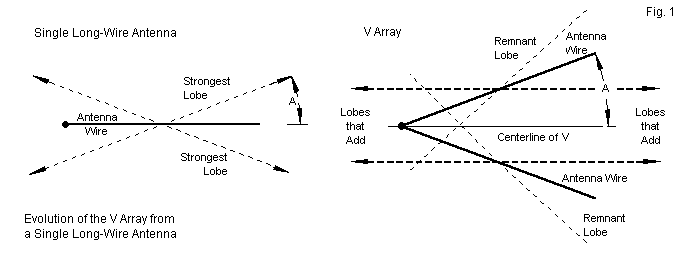
Utilizing the four rhombic arrays and three V-beams, the K0UO antennas efficiently encompass 14 directions, each spaced 25°, which is the beam width of each array.
Geographic Propagation Advantage of Kansas at this station, with less than 5 to 10 degrees take off angles, K0UO is always the first to open to Europe, Asia and over the poles to western Asia & Mideast, and it is always open to South America.

A Big advantage of all long Traveling wave antennas are known for fantastic Improvements in the reduction of QSB fading, for both transmit or receive. The Rhombic is the antenna that won WW2 for the west, used by both the VOA, DOD, and Wire services
It is like Diversity, theses large arrays cover a lot of area. My station uses miles of wire, so you are both listening and transmitting signals coming and going at different angles. Signal-to-noise ratio (S+N/N ratio, or SNR) is one technical aspect not too many amateurs give a second thought about, however if you can't hear them you can't work them. This is very apparent on audio reception, long Traveling wave antennas eliminates much of the audio amplitude fading for both transmit or receive. The RF signal is almost never in a stable phase relationship at both places at the same time. This means the signal will have random phase and amplitude differences. The arrival angle and polarization of incoming signals will change. This generally results in the fading, by having many wavelengths of wire in the air, the chances are that while one experiences a fade, the other will not. The power is in the diversity size of the array and what you can now hear with out QSB fading. Traveling wave antennas are just quieter and have substantial noise reduction. That is why so many people use the Beverage receive antennas. Traveling wave antennas are very unique and unlike many other antenna in common use, and modeling will not show this major advantage.
NOTE, Don't underestimate the performance of the Rhombic, unless you have personally built and used one.
TO SEE the complete Blog list check @ https://www.k0uo.com/k0uo

The KØUO Rhombic Antenna Farm in Kansas, consisting of many acres, with "Miles of Wire in the Air & On the Air". Best known as an antenna Experimenter, Ragchewer 1st and DXer for fun! "It takes years of Passion, Hard work, and Commitment to build a great station".

The KØUO Rhombic Antenna Farm and Antenna Test Range: Home to the World's Largest amateur radio (ham), High Frequency (HF) Wire Arrays, miles of wire in the air and on the air daily. From a technical and raw performance standpoint, K0UO it is the most powerful, unique, and highest-gain HF wire antenna farm still in existence anywhere in the world. While most ham systems rely on standard towers and stacked aluminum Yagi antennas, K0UO focuses on the "Lost Art" of massive, multi-acre wire arrays while using the newest technology.
Historic Preservation: The K0UO station diligently preserves and uses components and insulators from renowned, historic radio arrays, including those from W6AM (Don Wallace), W7YRV Roy, BBC, Voice of America (VOA), and many others.
"The K0UO station is unlike any other ham station globally," making it truly unique as a Big Gun Mega Station. It is one of the few capable of constructing and utilizing very large Rhombic and V Beams, along with a variety of other antennas and AI. K0UO features the largest operational HF wire antenna in the world.
"I hope others will carry on the tradition, and art of building the large Rhombic Arrays in the future". It is truly the "PHD" of wire antennas.

Remote operation users of K0UO
Note to contest operators, DXers, and others who have made arrangements to utilize the K0UO facility: you must first sign a non-disclosure agreement and adhere to the terms prohibiting the disclosure of the "exact location" of the K0UO site you are using. Currently, the site hosts several commercial DoD/DoW projects utilizing specific HF high-gain antennas using AI for complete control. These projects take precedence, and you will be informed if an antenna is unavailable at certain times. There are no exceptions to this rule, as agreed upon in the original agreement, which states that certain antennas are not guaranteed and may change without notice. This is in accordance with the Department of Defense utilization clause of the site (30 days on most current agreements).

The owner of the K0UO location receives hundreds of inquiries annually regarding remote use of the station for DX, casual amateur radio use, or extensive contests, including multi-multi operations. K0UO aims to be inclusive, but due to the limited number of operators that can access the facility simultaneously, a standard protocol is necessary. If you or your group have successfully negotiated an agreement, you must comply with the non-disclosure agreement. While many contests require station location disclosure, stating that the station is in Grid Square EM07, Barber County, Kansas, does not violate the agreement; only revealing the exact location or station owner/call would constitute a breach. If approved, please enjoy the station responsibly.
The facility houses tens of thousands of dollars in new Flex 8000 transceivers, amplifiers, sophisticated control and switching equipment, some of which are AI-operated, in addition to massive HF antennas such as Rhombic, V beams, Delta Loop quad-beams, four-square verticals, stacked log periodic LPDA, wire beams dipole stacked on a 195 foot tower, and a complete array of receive antennas from Beverages to loops, all with AI control from your QTH.
The agreement you or your group signed is confidential, prohibiting disclosure to others. This clause protects sensitive information and terms from unauthorized access. Each agreement is customized to meet the specific needs of both parties, considering factors like the relationship nature and agreement objectives. Adhering to these guidelines fosters trust and open communication while safeguarding interests. Breaching confidentiality can lead to legal repercussions and loss of trust, so it is crucial to respect and uphold the agreement's terms.
73
Steven Walz, K0UO
SEE ALL BLOGS Here, & Just Skip the first few pages, and go to the Blog List


Each one of K0UOs rhombic's take between 6 and 7 Acres of property 1200 foot end to end