


Math for the Rhombic & V Beams Array

Updated: Sep 14

The above is all the info/data that you need to build a Rhombic
The site emphasizes the scientific method: model → build → far-field test → refine


NOTE, Don't underestimate the performance of the Rhombic, unless you have personally built and used one. Because of their excessive size (area) covering many acres, you see their real advantage of thousands of feet of wire in the air, which creates receive signal diversity, by capturing signals at different times and different angles, vastly eliminating fading QSB, and firing out the transmitted RF in the same way. Traveling wave antennas are very unique and unlike many other antenna in common use, and modeling will not show this major advantage.
The site emphasizes the scientific method: model → build → far-field test → refine
K0UO uses AN-SOF with Scilab, NEC5 (newer MOM algorithm) from Lawerence Livermore Lab, but it still won't show the real performance of the Rhombic so test is still required. K0UO with the RSI Corp antenna Far Field Test Range uses advanced RF measurement to confirm all the antennas preformance.
A word about modeling: You no longer need the latest modeling software, as it's design is rapidly evolving with Artificial Intelligence.
We started integrating AI with modeling in 2024, and now have developed an AI analysis platform focused on antenna performance and specific parameters. Be cautious and invest time in setting the correct parameters for your "AI platform".
One high end paid AI platform is now using AN-SOF, which is a robust simulation engine designed for the modeling and analysis of complex antenna systems and radiating structures.
Gain total spatial awareness of your antenna’s performance with immersive 3D rendering. AN-3D Pattern utilizes colored mesh and surface mapping to visualize radiation lobes with professional clarity.
AN-SOF provides significantly higher simulation accuracy than legacy NEC software (such as NEC-2 or NEC-4) when modeling large traveling-wave antennas like Rhombics, Beverages, and long V-beams. Its performance advantage stems from how its computational engine handles wire geometry, acute angles, and ground physics
Only AN-SOF is somewhat capable of accurately simulating large traveling-wave antennas, including Rhombics, Beverages, and extensive V-arrays. This is achieved through its advanced Conformal Method of Moments (CMoM) engine, complemented by comprehensive Sommerfeld ground physics.
The Exact Kernel Advantage: Legacy NEC tools struggle with localized "current bunches" near lumped loads or sharp transitions. Because AN-SOF calculates currents over the actual tubular surface of the wire (the Exact Kernel) rather than an infinitely thin line, it more precisely models how the current transitions from a traveling wave into a termination load.
Exact Kernel vs. Thin-Wire Approximation
NEC Limitation: Legacy NEC engines rely on the thin-wire kernel approximation, assuming electric current flows along an infinitely thin line down the wire axis. Near lumped termination loads (such as a 600Ω resistor) or abrupt geometry transitions, this approximation creates non-physical current spikes ("current bunches").
AN-SOF Advantage: Operates on the Conformal Method of Moments (CMoM) with an Exact Kernel, integrating currents over the true cylindrical surface area (2πa) of the wire. This accurately captures the smooth transition from a progressive traveling wave into the termination load.
Apex Junction Stability
NEC Limitation: Traveling-wave arrays like Rhombics and V-beams feature sharp acute apex angles where wires meet at narrow corners. In NEC-2/4, closely spaced segments near acute corners trigger mathematical breakdown, miscalculating mutual coupling.
AN-SOF Advantage: CMoM satisfies boundary conditions across acute angles and close wire spacings without numerical instabilities or artificial "bent wire" artifacts.
Ground Physics & Near-Field Losses
NEC Limitation: Low-height traveling-wave antennas (especially Beverages) depend heavily on ground losses. Older NEC tools often use Reflection Coefficient Approximations (RCA), which fail in the near-field and oversimplify ground return currents.
AN-SOF Advantage: Implements the Sommerfeld-Wait ground model, providing accurate calculations for near-field ground absorption, input impedance, and low-angle radiation patterns over lossy earth.
Importance of Far Field Testing in HF Traveling-Wave Arrays
Performing actual Far Field testing remains a crucial requirement for numerous high-frequency (HF) Traveling-wave array projects. This testing methodology is not merely a formality; rather, it serves as an essential component in validating the performance and efficiency of the arrays. The Far Field testing process involves measuring the electromagnetic fields produced by the array at a considerable distance, where the effects of the antenna's near-field influence diminish, allowing for a more accurate assessment of its radiative characteristics.
Understanding Far Field Testing
The significance of Far Field testing lies in its ability to provide critical insights into the radiation patterns, gain, and overall efficiency of the HF Traveling-wave arrays. In the context of HF frequencies, where wavelengths can be relatively long, the precision in measuring the antenna's performance becomes even more vital. Far Field testing enables engineers and researchers to capture data that reflects how the array will perform in real-world scenarios, including various atmospheric conditions and operational environments.
Creating a well-designed platform using scientific and engineering knowledge is crucial.
Relying solely on ChatGPT is not the solution at all!
K0UO & RSI Corp, which employs Artificial Intelligence for designing traveling wave and other antennas, is significantly more reliable and completes the process in just 5% of the time needed by traditional modeling programs. While setting it up requires time, akin to the initial setup of the original computer modeling software, it's crucial to remember that assuming artificial intelligence operates flawlessly can lead to mistakes.
After designing, we confidently utilize our outdoor testing range to validate the results. Confirming results and assessing performance in real-world conditions is essential. Over the years, my team has effectively collaborated with numerous commercial clients to achieve this.
I started with calculators, and some of us are old enough to remember using slide rules and pencils, before moving to computer modeling. It's astonishing to see how far we've come, and in a few more years, like it or not AI will further revolutionize antenna design.
Artificial Intelligence (AI) and Machine Learning (M/L) are revolutionizing how engineers analyze, design, and troubleshoot complex antenna radiation patterns. In traditional RF (Radio Frequency) engineering, evaluating massive setups—like multi-element wire arrays or phased arrays—requires staggering amounts of mathematical computation or weeks of field testing
AI bypasses these bottlenecks by automating pattern recognition and predicting electromagnetic behavior in real time we are using it now on the test range.
L. B. Cebik, W4RNL Model below
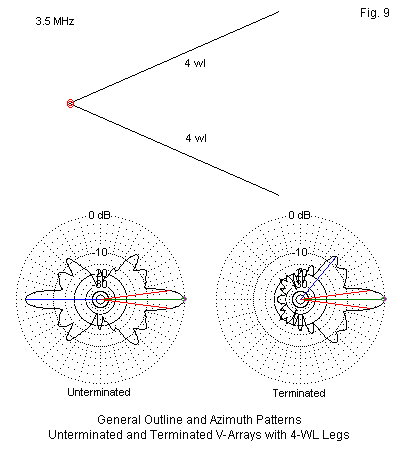


WA7ARK recommends NEC5 (newer MOM algorithm) from Lawerence Livermore Labs greatly adds to modeling capability (adds buried conductors) and makes it much easier to write models (many less restrictions compared to NEC2d)
K0UO now model all antennas using AN-SOF, NEC5 and HFTA (High Frequency Terrain Analysis) to evaluate the take of angle of the various antennas over real ground, and use 3/8" Triple Galvanized Wire Rope Cable is used for the antenna wire.
Modeling Traveling-wave Arrays
AN-SOF provides significantly higher simulation accuracy than legacy NEC software (such as NEC-2 or NEC-4) when modeling large traveling-wave antennas like Rhombics, Beverages, and long V-beams. Its performance advantage stems from how its computational engine handles wire geometry, acute angles, and ground physics
Only AN-SOF is somewhat capable of accurately simulating large traveling-wave antennas, including Rhombics, Beverages, and extensive V-arrays. This is achieved through its advanced Conformal Method of Moments (CMoM) engine, complemented by comprehensive Sommerfeld ground physics.
The Exact Kernel Advantage: Legacy NEC tools struggle with localized "current bunches" near lumped loads or sharp transitions. Because AN-SOF calculates currents over the actual tubular surface of the wire (the Exact Kernel) rather than an infinitely thin line, it more precisely models how the current transitions from a traveling wave into a termination load.
Exact Kernel vs. Thin-Wire Approximation
NEC Limitation: Legacy NEC engines rely on the thin-wire kernel approximation, assuming electric current flows along an infinitely thin line down the wire axis. Near lumped termination loads (such as a 600Ω resistor) or abrupt geometry transitions, this approximation creates non-physical current spikes ("current bunches").
AN-SOF Advantage: Operates on the Conformal Method of Moments (CMoM) with an Exact Kernel, integrating currents over the true cylindrical surface area (2πa) of the wire. This accurately captures the smooth transition from a progressive traveling wave into the termination load.
Apex Junction Stability
NEC Limitation: Traveling-wave arrays like Rhombics and V-beams feature sharp acute apex angles where wires meet at narrow corners. In NEC-2/4, closely spaced segments near acute corners trigger mathematical breakdown, miscalculating mutual coupling.
AN-SOF Advantage: CMoM satisfies boundary conditions across acute angles and close wire spacings without numerical instabilities or artificial "bent wire" artifacts.
Ground Physics & Near-Field Losses
NEC Limitation: Low-height traveling-wave antennas (especially Beverages) depend heavily on ground losses. Older NEC tools often use Reflection Coefficient Approximations (RCA), which fail in the near-field and oversimplify ground return currents.
AN-SOF Advantage: Implements the Sommerfeld-Wait ground model, providing accurate calculations for near-field ground absorption, input impedance, and low-angle radiation patterns over lossy earth.
Importance of Far Field Testing in HF Traveling-Wave Arrays
Performing actual Far Field testing remains a crucial requirement for numerous high-frequency (HF) Traveling-wave array projects. This testing methodology is not merely a formality; rather, it serves as an essential component in validating the performance and efficiency of the arrays. The Far Field testing process involves measuring the electromagnetic fields produced by the array at a considerable distance, where the effects of the antenna's near-field influence diminish, allowing for a more accurate assessment of its radiative characteristics.
Understanding Far Field Testing
The significance of Far Field testing lies in its ability to provide critical insights into the radiation patterns, gain, and overall efficiency of the HF Traveling-wave arrays. In the context of HF frequencies, where wavelengths can be relatively long, the precision in measuring the antenna's performance becomes even more vital. Far Field testing enables engineers and researchers to capture data that reflects how the array will perform in real-world scenarios, including various atmospheric conditions and operational environments.
Applications and Benefits
The applications of Far Field testing in HF Traveling-wave arrays are vast, spanning military communications, broadcasting, and scientific research. For instance, in military applications, the reliability of communication systems can significantly impact operational effectiveness. Thus, ensuring that the Traveling-wave arrays can perform optimally at long distances is paramount. Similarly, in broadcasting, achieving the desired coverage area and signal quality is essential for reaching audiences effectively. Moreover, Far Field testing provides a benchmark for comparing different array designs and configurations. By analyzing the results, engineers can make informed decisions regarding modifications or enhancements to the array structure, ultimately leading to improved performance metrics. This iterative process of testing and refinement helps in achieving arrays that not only meet but exceed operational specifications.
Challenges and Considerations
Despite its importance, conducting Far Field testing presents certain challenges. The setup for such tests can be complex, requiring specialized equipment and controlled environments to minimize interference from external sources. Additionally, the interpretation of the data gathered during testing can be intricate, necessitating a deep understanding of electromagnetic theory and antenna behavior. Furthermore, advancements in simulation technologies have led some to question the necessity of physical testing. While simulations can provide valuable preliminary insights, they cannot entirely replace the need for actual Far Field measurements. The real-world variables that affect antenna performance can only be accurately captured through empirical testing.
Conclusion
In conclusion, the practice of performing actual Far Field testing remains indispensable for many HF Traveling-wave array projects. It not only validates the theoretical models but also ensures that the arrays can operate effectively in practical applications. As technology continues to evolve, the methodologies surrounding Far Field testing will likely adapt, but the fundamental need for this rigorous testing process will persist in ensuring the reliability and efficiency of HF communication systems.
The old books say, "The gain of a rhombic with side lengths of four to five wavelengths is over 40 times that of a half wave dipole. About one half of this gain is realized by using two wave lengths to each of the four sides" From the old DoD Book, EI8IC Reprint
Also at the K0UO rhombic farm and antenna test range, the world’s largest facility dedicated to advanced antenna design and testing, engineers push the boundaries of what’s possible. We don’t just guess antenna gain - we measure it meticulously, ensuring every antenna performs at its peak.
Today, nearly all HF amateur radio Yagi beam antennas, along with numerous commercial HF beams, remain unevaluated on antenna far-field test ranges. While VHF and higher frequency band antennas have undergone informal testing by organizations like The Central States VHF Society and Microwave Update, exposing deficiencies in some manufacturers' models and claims, there is a notable lack of real-world far-field testing for HF antennas, including wire-based and high-performance Yagi beams. Manufacturer documentation often misleads consumers.

NOTE: Do not underestimate the performance of the Rhombic unless you have personally built and used one. Despite their large size, covering many acres, their real advantage lies in having thousands of feet of wire in the air. This setup creates receive signal diversity by capturing signals at different times and angles, significantly reducing fading QSB and efficiently transmitting RF. Traveling wave antennas are unique and unlike many other commonly used antennas, and modeling does not reveal this significant advantage.
Keep in mind that K0UO is comparing rhombics to large stacked single band yagis beams that were previously used on 195-foot rotating towers at K0UO, and has tested both yagis and rhombics on the RSI Corp antenna test range. "Rhombics bets Beams"
Based on the site other blogs content, our four 40‑meter resonant rhombic antennas at K0UO are aimed at the primary DX directions as part of the farm’s 14‑direction coverage (arrays and V‑beams every ~25°). The blog posts and site notes identify collective coverage rather than a numbered compass heading for each rhombic, but they state the system was laid out to target the eight main DX areas and that the full farm (four rhombics + three V‑beams) provides beams every ~25°. Specifics given in the material: the arrays serve NE/Europe, Africa/Mideast, Central & South America, Oceania/Asia and other DX sectors; one vertical‑polarized 1/2 rhombic is noted as firing to Central & South America.
The K0UO amateur ham radio antenna range, and testing site has the use of over a 1200 acres around the main antennas for far field measurements, using a portable tower or drone loaded with calibrated RF EME survey instruments (used for DOD/ Govt, Commercial and amateur radio), see the far field test page. https://www.k0uo.com/post/model-and-then-do-far-field-test
The K0UO antenna test range site makes use of the 4KS Walz airport and its surrounding area as a practical learning environment for STEM (Scientific, Technical, Engineering, & Mathematics) antenna projects in a real-world outdoor setting. If your group has a university aerospace or antenna research STEM program, please let me know. The KØUO Rhombic Antenna Farm and Antenna Test Range: Home to the World's Largest amateur radio (ham), High Frequency (HF) Wire Arrays, miles of wire in the air and on the air daily.

See the other pages on K0UO for much more design info
TO SEE the complete Blog list check @ https://www.k0uo.com/k0uo
TIP: It is a Blog, so just SKIP the Blogs HEADER and go down to the blog.
SEE ALL BLOGS Here, & Just Skip the first few pages, and go to the Blog List

To build a 20 meter Rhombic to get 10D takeoff


Comments